Flower Mound Wood Flooring installs and refinishes wood flooring in Bedford, and we have been doing this work for more than twenty years, the last two decades of it on North Texas slabs. Almost every job we take here starts with a floor that is already down. What comes up first shapes the schedule, the price and the finished result more than the boards you pick out.
That is the practical difference between a Bedford job and a job in a suburb that is still filling in. There is no bare subfloor waiting for us. There is carpet over pad, sheet vinyl bonded down over a felt back, or a parquet field glued straight to the concrete, and the removal and disposal of it belong in the quote rather than in a surprise discovered on day one.
We put a written scope in your hands before anyone arrives with a trailer, and we test for moisture before an installation date is set rather than after the boards are on site. If a screen and recoat will get you where you want to be, we will say so instead of selling a full sand. The rest of this page is about what actually changes when the house is forty years old.
Bedford stopped building, and that changes the job
Bedford is a finished city in the housing sense, and the numbers are not close. Only 12.6% of the city’s 21,878 housing units were built in 2000 or later, and just 3.0% since 2010. A wood floor sold in Bedford is a replacement floor, essentially without exception.
Replacement-only demand, priced where you can see it
When 652 of 21,878 units postdate 1999, first-install work is a rounding error. Every quote we write here carries a tear-out line, a disposal line and a subfloor prep line, because all three are certain. We would rather show you those numbers separately than average them into a per-square-foot figure that hides them.
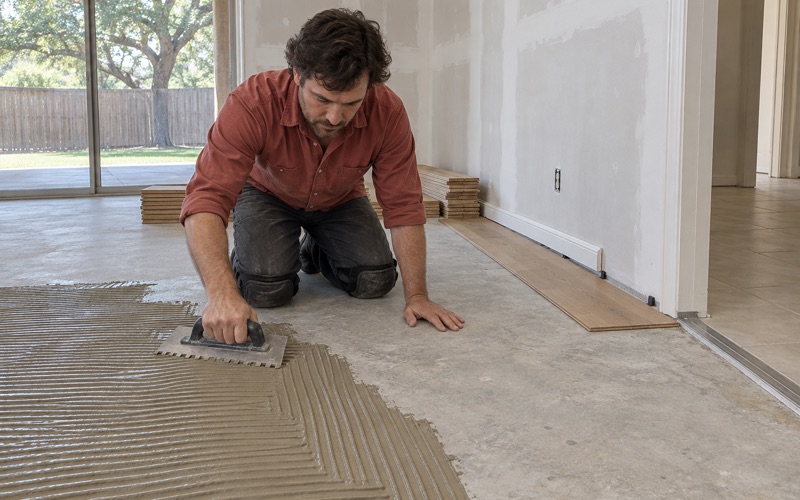
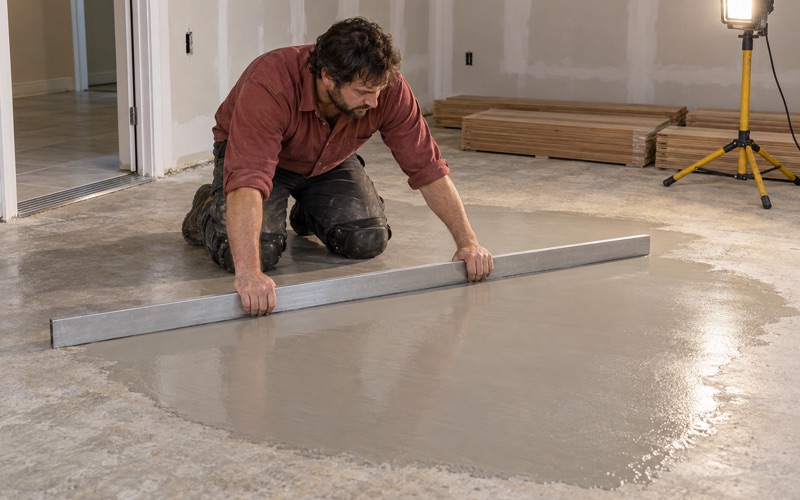
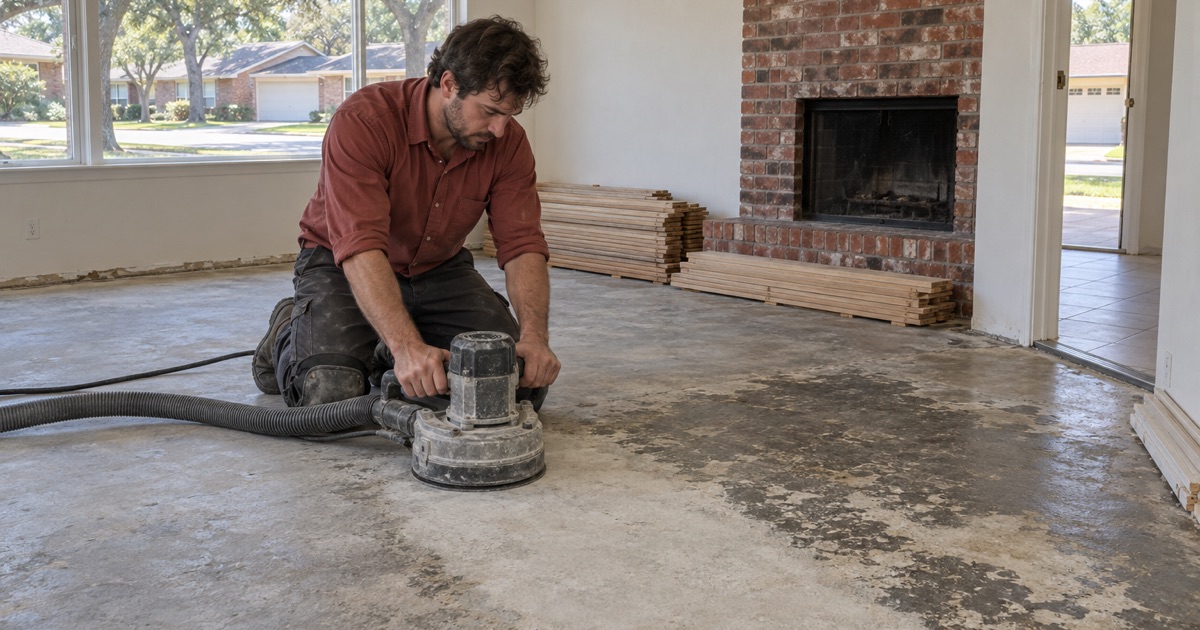
The prep line is the one that moves. A subfloor that reads flat under a straightedge needs nothing, while one that does not needs concrete grinding at the high spots or self-leveling underlayment in the low ones to reach the subfloor flatness tolerance the manufacturer publishes. We measure that before we price it, not after.
A city that filled in between 1970 and 1990
The growth curve explains the housing stock better than any single year does. Population went from 10,049 in 1970 to 43,762 in 1990, and the construction that absorbed those two decades is what we are pulling up today. Apartment zoning arrived in 1968, and the zoning fights over apartments and commercial ground ran on through the years that followed.
The result is a stock built quickly, to the spec of its moment, and then left alone. Builder-grade carpet, sheet vinyl and glued parquet were all ordinary choices in those years. None of them were designed to still be in service in the 2020s.
Owners and renters on the same street
Occupied units split almost evenly: 50.6% are owner-occupied, and 10,206 of the 20,658 occupied units are renter-occupied. Single-family detached houses make up 52.9% of the stock, and 9,747 of those detached houses are owner-occupied. So one block routinely carries an owner planning a fifteen-year floor and a landlord specifying a floor that has to survive turnover.
We quote both, and we do not pretend they are the same job. A long-horizon remodel earns a thicker wear layer and a species chosen deliberately, since white oak, red oak and hickory sit at different points on the Janka hardness rating. A rental floor earns fast cure and a surface that can be screened and recoated between tenants instead of sanded.
Looking for wood-flooring closer to North Richland Hills? See Wood-Flooring Services in North Richland Hills.
What comes up before anything goes down
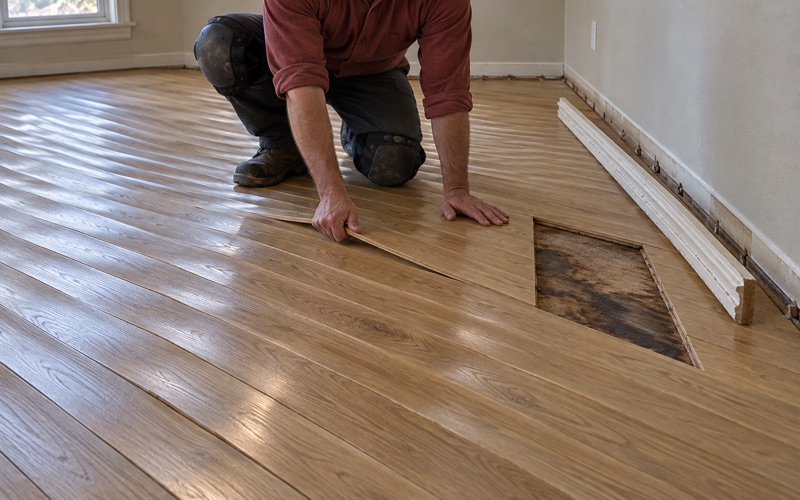
Tear-out is not demolition here; it is the diagnostic. What sits under the old floor decides the installation method, the moisture plan and sometimes the calendar. We would rather learn that on the first morning than on the day the boards are supposed to go down.
Forty-year-old builder flooring, and what hides beneath it
The dominant cohort is now roughly forty years old: 36.8% of units were built in the 1980s and 20.4% in the 1970s, 57.2% of the stock across those two decades. That is well past the service life of the original builder-grade carpet, vinyl and parquet. It is also long enough that what we lift is frequently not the original floor at all, but a replacement somebody laid over it.
Layered floors change the arithmetic. Glued parquet leaves adhesive behind, sheet vinyl leaves a felt back bonded to the substrate, and a floating floor laid over either one leaves nothing except whatever it was hiding. Each of those is a different removal, and each produces a different volume of debris.
Disposal is part of the work, not an afterthought
The debris from a whole-house tear-out is heavier and bulkier than most homeowners expect, particularly once adhesive residue and old underlayment come with it. We carry it out, haul it and dispose of it, and that cost sits in the written scope where you can read it. Nothing is left in the driveway over a weekend.
We seal the work area off from the rest of the house before any of it begins. Sanding is dustless with containment, furniture goes out and comes back rather than migrating room to room, and the space is left clean at the end of each day instead of at the end of the job. On an occupied remodel that is the difference between living in the house and moving out of it.
Testing the substrate rather than guessing at it
Where the floor sits on a concrete slab, the concrete is the variable that ruins wood floors quietly. We run an ASTM F2170 in-situ relative humidity test before an installation date is committed, and a pinless moisture meter goes over any wood already in the house. A calcium chloride test has its place, but the in-situ reading is what we will set a date against.
If the number comes back high, the answer is a vapor retarder, a different adhesive system, or waiting, rather than proceeding and hoping. Boards then acclimate inside your house before a single cleat or staple is driven. Cupping, crowning and seasonal gapping are moisture stories more often than they are product failures, and preventing them is far cheaper than sanding them out.
Bedford is still on the 2018 codes
Which code edition a city has adopted stops being trivia the moment a floor job touches another trade. Bedford enforces the 2018 editions of the International Building, Residential, Mechanical, Plumbing, Fuel Gas, Energy Conservation, Swimming Pool and Spa, and Fire Codes, along with the 2017 National Electrical Code. We work to the edition your town has actually adopted rather than to a generic national one.
The adopted edition, not the newest one
That distinction matters because surrounding jurisdictions are not all on the same cycle, and a contractor who assumes the newest edition will get details wrong. The City of Bedford Development Department’s Inspections Division is the authority that signs off here, inside Tarrant County. We confirm the adopted edition before we schedule anything that needs an inspector.
Most refinishing work triggers no permit at all, because sanding and recoating an existing floor is maintenance. The code question arrives when flooring runs alongside something else: a subfloor repair, a plumbing repair, a relocated register, or wiring run under a threshold. Those are the jobs where both the edition and the inspection sequence start to carry money.
Multifamily has a calendar of its own
If you own or manage an apartment property here, the city’s multi-family registration and inspection program adds a layer. Registration is annual and required again on change of ownership, and the city inspects the complex each year and scores it on a 100-point scale. Tier 1 properties are not reinspected for a year, Tier 2 twice a year, and Tier 3 three times in a calendar year.
That scoring calendar is a scheduling constraint, not just paperwork. We would rather sequence unit turns and common-area flooring around a known inspection window than have a crew mid-sand when the inspector walks the property. Tell us the tier and the month and we will build the schedule backward from it.
Water damage and the paper the claim needs
Water is the other place documentation decides the outcome. When a floor comes up because of a supply line or a leak under the house, we record it the way a claim needs it recorded: dated photographs, moisture readings and an itemized scope. That file is worth considerably more than a verbal description when an adjuster is deciding what gets covered.
We also sequence around foundation work and plumbing repairs instead of laying a floor over a substrate that is still moving. If a repair is already scheduled, the floor waits for it. That is an unwelcome thing to hear when you want a date, and it is still the right order to do the work in.
Covering work before it is inspected costs money here
Bedford’s local amendments to the building code add two fees worth knowing about before a floor goes down. Both are about sequencing rather than workmanship, and both are avoidable. On an occupied remodel they are also easy to trip over.
Section 109.9, the unauthorized cover-up fee
The amendments add Section 109.9, an unauthorized cover-up fee: any work concealed without first obtaining the required inspection, in violation of Section 110, is assessed a fee set by the city fee schedule. A finished floor is, by definition, a cover. If a trade ran under it or behind it and that work was never inspected, the floor is the thing that hid it.
So on any job where plumbing, electrical or a subfloor repair comes before the flooring, we hold the installation until the inspection is signed off. That occasionally costs a day. It costs considerably less than a fee plus the price of opening a finished floor back up to expose what should have been looked at.
Section 109.7, the re-inspection fee
The same amendments add Section 109.7, a re-inspection fee, chargeable when the inspection called for is not ready as the inspector arrives, or the building is locked, or the work is otherwise unavailable for inspection. On an occupied remodel every one of those is a realistic way to lose a morning. Someone has to be there, the area has to be clear, and the work has to genuinely be finished.
We treat access as part of the schedule rather than as the homeowner’s problem. One crew works your house from the first day to the last, so there is no handoff where a key or a callback goes missing, and the sanding is never passed to a subcontractor. When an inspection is on the calendar, we clear the area the day before instead of the morning of.
Sequencing the finish around all of it
The finish schedule is the last thing to get squeezed and the first thing to show it. Waterborne polyurethane cures faster and stays clearer, oil-modified polyurethane ambers and takes longer to walk on, and hardwax oil is repairable in place but asks for a different maintenance habit. Sheen level is a look decision, and each of those systems carries a sheen differently.
We run the full grit sequence with a drum sander, edger and orbital sander rather than skipping a step to save a day, because a skipped grit shows through a finish and not before. Where the boards are sound and only the surface is tired, a screen and recoat with a buffer gets you a new floor in a fraction of the time. We will tell you honestly which of those your floor actually needs.
- 20+ Years on Wood Floors
- Dustless Sanding and Containment
- Written Scope Before Work Starts