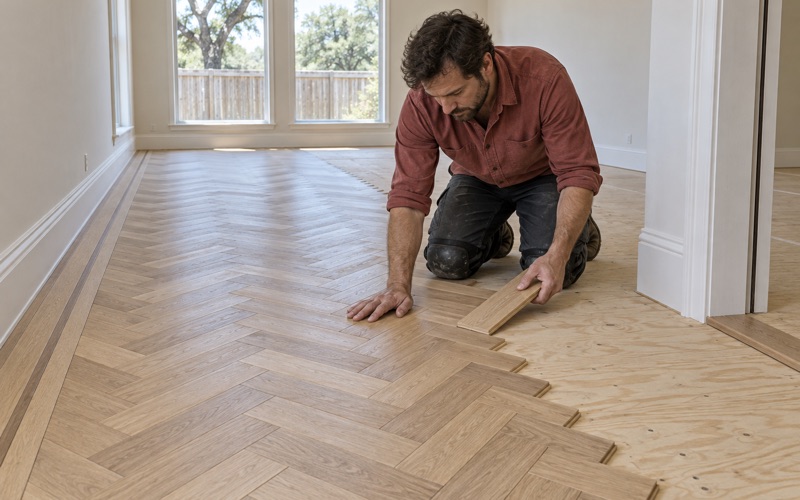
Flower Mound Wood Flooring has handled hardwood floor repair in Carrollton for more than twenty years, and almost all of that time has been spent on North Texas floors rather than somewhere else. A repair here is seldom just a board: it is a board, whatever it is fastened to, and the build year that decided both.
That is why our first visit is an inspection and not a quote sheet. We read moisture at the surface and, where there is concrete, below it; we watch how the floor moves under weight; and we work out what era of construction we are standing on. Only after that do we put a date and a number on the work.
We also price the depth of the repair plainly. If a screen and recoat will bring the surface back, we say so rather than sell a full sand, and if the wear layer is spent we say that too. The scope is written before the first day, so the price is not discovered halfway through the job.
Carrollton Heights: Craftsman through mid-century, and what each era left under the carpet
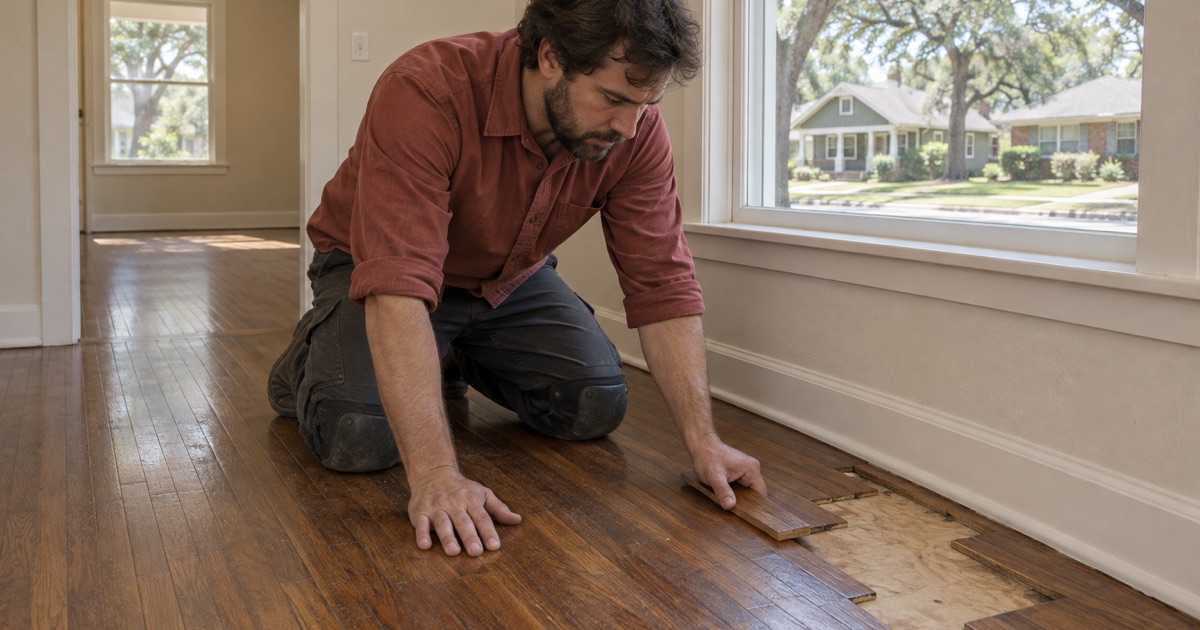
Carrollton Heights is what makes this city unusually varied to work in. The historic district covers domestic architecture built between 1910 and 1960 and holds nearly every style developed across that half-century — Craftsman bungalow, Prairie, Tudor and Colonial Revival, Ranch and post-war mid-century modern — north of Belt Line Road between Denton Drive, Warner Street and the Cotton Belt Railroad.
The district did not grow in isolation. Merchants began forming what is now the Downtown Carrollton Square from 1900, and by the city’s incorporation in June 1913 the Square sat at the center of a community with rail access in every direction; the first gazebo went up in 1921.
The 1908 flood and the higher ground the old houses stand on
This neighborhood exists because of water. The 1908 flood destroyed many of the homes in downtown Carrollton and prompted residents to rebuild on higher ground, at the site of a free-flowing fresh spring that served as the municipal water supply. That was a drainage decision made a century before anyone wrote a moisture specification, and it still shapes how these floors behave.
Higher ground is not the same thing as a dry floor, though. Where a house of that era still sits over a ventilated crawl space, a blocked vent or a slow supply leak will cup a room of oak long before a stain shows on the surface. We meter the boards and the framing under them with a pinless moisture meter, and we prefer to find the source before the sander comes off the truck.
Craftsman, Prairie and Tudor floors: narrow strip oak and where it gives out
Floors from the early end of the district are usually narrow strip red oak or white oak laid over a board subfloor, and most have been sanded more than once already. The useful question is not how the finish looks but how much wear layer is left above the tongue. We measure that at a register cut or a threshold rather than guessing from the top.
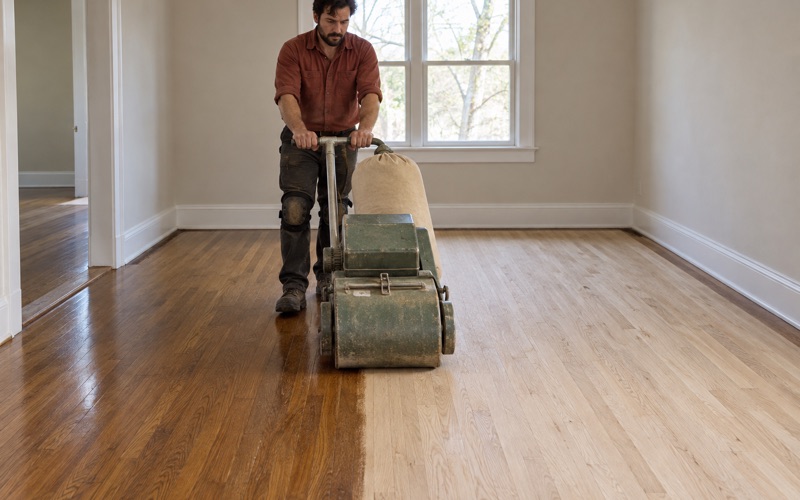
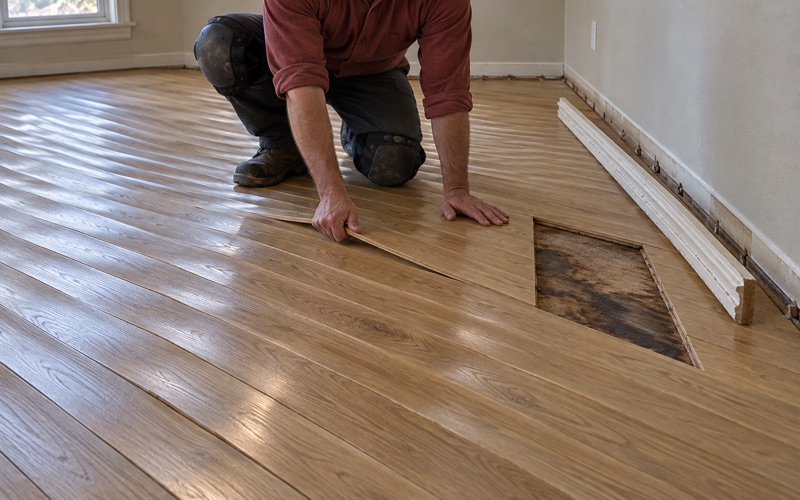
Where there is enough material left, a full sand through a proper grit sequence — drum sander in the field, edger at the perimeter, buffer to blend — brings a ninety-year-old floor back with no new boards at all. A dutchman patch is honest work for a localized wound, and a weave-in repair is what a whole damaged doorway needs.
Ranch and mid-century boards at the newer end of the district
The Ranch and mid-century modern houses at the later end of the span often kept the same strip oak but ran it into larger, more open rooms, which changes what a repair has to hide. We test stain and sheen on site, in that room’s own light, before committing the floor.
Finish choice matters more here than most people expect. Oil-modified polyurethane ambers over time and can sit well with a period floor, waterborne polyurethane stays clearer and cures faster, and hardwax oil gives a low sheen level that spot-repairs without a full recoat.
Looking for wood-flooring closer to Euless? See Euless Wood-Flooring.
The 1970s and 1980s slab city and the floors that go over it
Most of Carrollton was not built in the historic era, and the repair work reflects that. 15,462 housing units went up in the 1980s and 9,688 in the 1970s, so a very large share of the city’s floors sit on concrete poured inside a twenty-year window.
Blackland Prairie clay and a slab that is still moving
Dallas County lies largely within the Blackland Prairie, developed on the Eagle Ford Shale, which contains bentonite whose montmorillonite content produces differential swell and contraction reported at up to seven inches — a known cause of foundation and roadway problems. We do not diagnose foundations, and we do not assert what any individual house is built on. What we do is read the floor for the symptoms that clay movement leaves behind.
Cupping, crowning, tenting and seasonal gapping all have more than one possible cause, and the sequencing matters more than the label. If foundation work or a plumbing repair is coming, the floor goes in after it rather than before. We would rather move a date than lay boards over a slab that is still finding its level.
Testing the slab before a date is set
We test the slab for moisture before an installation or repair date is set, not after the boards are already on site. That means an ASTM F2170 in-situ relative humidity test in the concrete itself, a calcium chloride test where surface emission is the question, and readings taken across the room rather than at one convenient spot.
Where the numbers call for it, a vapor retarder or a compatible moisture-control membrane goes down before anything else. Boards then acclimate inside your house, in the room they will live in, before a single one is fastened down.
Glue-down, floating or nail-down over concrete
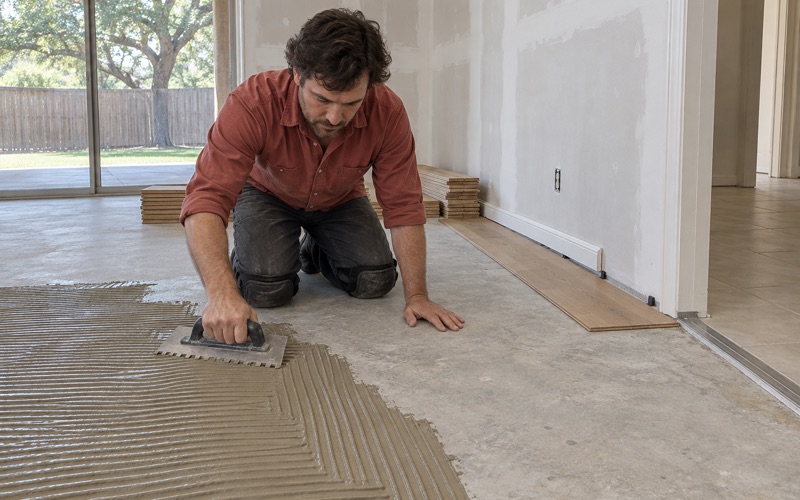
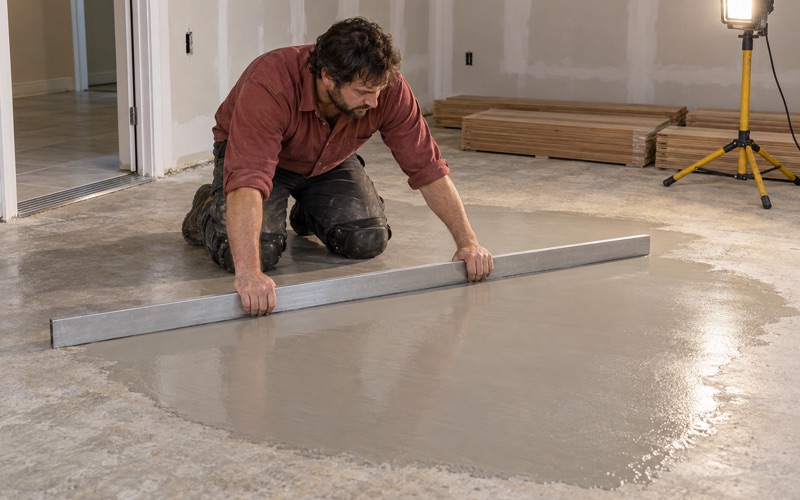
Subfloor flatness tolerance decides more installations than product preference does. High spots come down with concrete grinding, low spots come up with self-leveling underlayment, and only then is a method chosen. Glue-down suits engineered hardwood over a flat, dry slab, floating tolerates a little more movement, and nail-down needs a fastened subfloor built over the concrete first.
Where a slab is post-tension, nothing gets fastened into it, and we treat that as a hard limit rather than a preference. Expansion gap is the other detail that gets trimmed and then regretted, because a floor with nowhere to move buckles against the wall it was pinned to.
Three counties, three appraisal districts, and the department that signs off
Carrollton sits in Dallas, Denton and Collin counties, which stops being trivia the moment you need paperwork. Parcel records, ownership history and assessed values for an address in this city come from one of three different central appraisal districts, depending on where in the city that address falls.
Which appraisal district holds your parcel
An address in the Dallas County portion is recorded with the Dallas Central Appraisal District, one in the Denton County portion with the Denton Central Appraisal District, and one in the Collin County portion with the Collin Central Appraisal District. We use that record for the year built, which tells us what construction to expect before we open a closet.
The record and the floor do not always agree. A house recorded in one decade may carry a floor added two remodels later, so we go by what the boards and the subfloor actually say. Where a sale is involved, an itemized written scope is easier to attach to a TREC Seller’s Disclosure Notice than a verbal summary of what was done.
Permits and the code edition your address actually falls under
Permitting for work affecting structure, systems or occupancy runs through the City of Carrollton Building Inspection Department. As we understand the local process, review is against the International Code series as adopted here, with local and North Texas regional amendments layered on rather than a bare national edition.
We work to the edition a town has actually adopted rather than a generic national one, which means confirming the current adopted set with the department for your address instead of assuming it. Most refinishing is not permit work, but the framing, plumbing or subfloor repair sometimes attached to it can be.
Two forecast zones, one city, and what a claim needs
The split is not only administrative. A National Weather Service public forecast zone boundary runs through the city: a point in the Dallas County portion returns forecast zone TXZ119 and county zone TXC113, while a point in the Denton County portion returns forecast zone TXZ103 and county zone TXC121. These are zone assignments rather than measured climatological normals.
That matters when a storm or a burst supply line puts water on a floor, because the two halves of the city can be under different wording on the same day. Water damage jobs leave here with the documentation a claim needs: dated photographs, moisture readings taken over time, and an itemized scope.
Matching a Carrollton floor to a Carrollton build year
Every repair we quote sits somewhere on a ladder, and we tell you which rung it belongs on. A screen and recoat refreshes a finish that is worn but intact, a full sand resets a floor with real damage and enough wear layer left to take it, and board replacement handles what neither can reach. Selling the top rung when the bottom one would do is how a wear layer gets spent early.
Species, hardness and what will actually match
Red oak and white oak cover most of what is already down in this city, and matching grain and cut matters more than matching a stain name. Hickory turns up in later remodels and brings a much higher Janka hardness rating along with far more color variation. We source repair stock against the existing floor rather than against a catalog page.
Solid hardwood and engineered hardwood are not interchangeable over concrete, and wear layer thickness is the number that decides how many future sandings a floor still owes you. We would rather set that expectation at the quote than at the third refinish.
Patches, transitions and stairs
Transitions are where a repair either disappears or announces itself. A T-molding, a reducer at a tiled entry and quarter round at the baseboard all have to be chosen with the repair rather than after it. On a lacing job we run replacement boards into the field at staggered lengths so the seam has no straight line to follow.
Stairs are their own project. A stair nosing, tread and riser take wear no field board ever sees, and refinishing them takes the staircase out of use for a stretch we would rather name in advance than have you discover.
How the work runs in your house
Sanding is done dustless with containment, and the rest of the house is sealed off from the work area. Furniture goes out and comes back, and the room is left clean at the end of each day rather than at the end of the job.
One crew works your floor from the first day to the last, and the sanding is never handed to a subcontractor. That continuity is what lets a Craftsman bungalow floor and a 1980s slab-on-grade floor both come out the way they were quoted.
- 20+ Years on Wood Floors
- Dustless Sanding and Containment
- Written Scope Before Work Starts