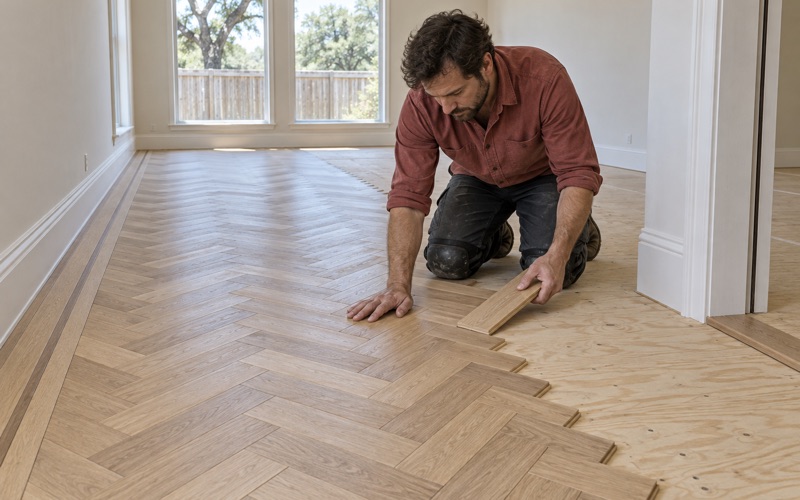
Flower Mound Wood Flooring installs and refinishes wood flooring in Colleyville, TX, and we have spent more than twenty years on North Texas slabs rather than learning this ground somewhere else. Nearly every floor we put down in this city goes in around a family that is still living in the house while we work.
That one condition sets the shape of the whole job. Of the 9,072 occupied homes in Colleyville, only 299 are rented, so there is effectively no vacant-unit turnaround market here. Dust containment, room-by-room sequencing and the cure clock belong in the scope of nearly every quote we write, rather than in an occasional accommodation for a fussy customer.
So we plan the work the way you will have to live through it. You get a written scope before anything starts, one crew from the first morning to the last day, and a route kept open from the garage to the bedroom wing while the floor in between is under a sander.
Living in the house while the floors go in
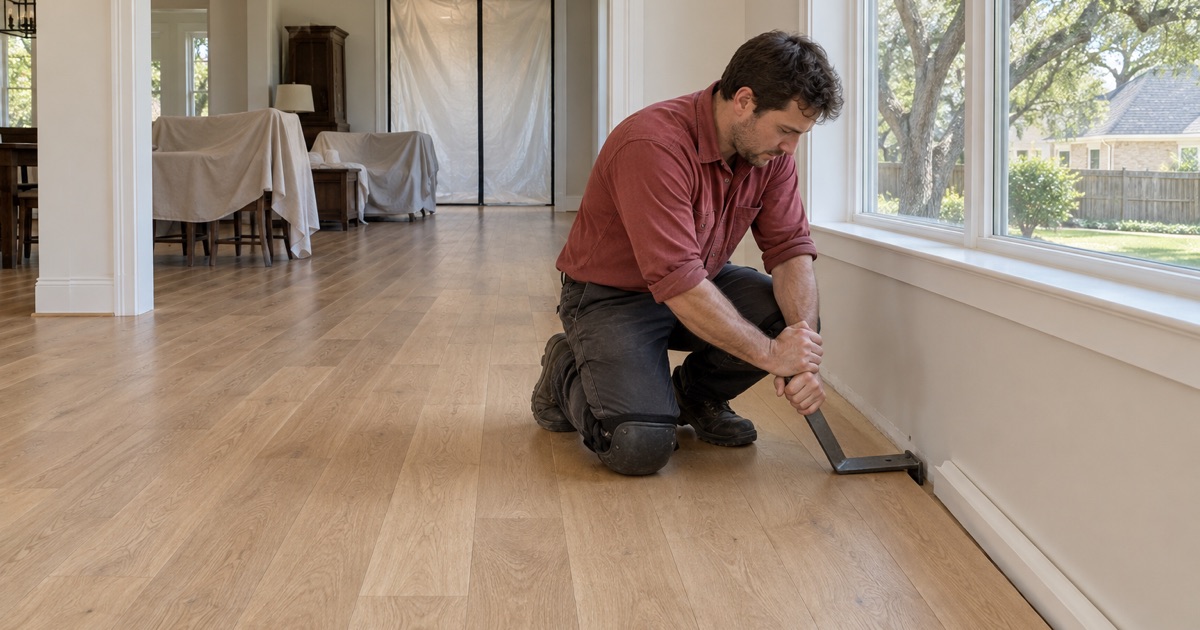
An installation in an occupied home is a logistics problem before it is a carpentry problem. We walk the house first, agree what moves and what stays, and decide which rooms stay yours on which nights. That conversation happens before a date is booked, because the answer often changes the order of the work.
Sealing the house off from the work area
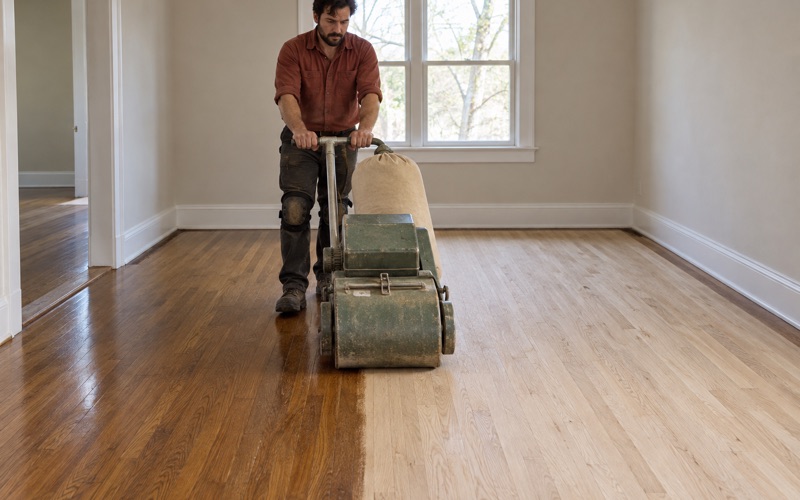
Our sanding is dustless, with containment at the machine and plastic at every doorway into the work zone. Supply and return vents inside that zone get covered so the HVAC system does not carry fine dust through the rest of the house overnight. The drum sander, the edger and the buffer all run on extraction rather than bags.
No sanding operation is literally dust-free, and we would rather say so than let you discover it. What containment buys you is a house where the kitchen counters and the closets are clean at the end of a day the living room spent under a grit sequence.
Sequencing a house that cannot be emptied
A family that cannot move out usually cannot have the whole floor done in one pass. We split the work in halves and keep a path between them, so the bedrooms stay reachable while the main living space is open, then reverse it. Entries and kitchens get scheduled where they interrupt the least.
Furniture goes out and comes back as part of the job rather than as your weekend project, and the room is left clean at the end of each day. Pets are the other half of the plan: a cured finish and a curious dog are compatible, a green finish and a curious dog are not, so the schedule follows when the animals can be elsewhere.
Who signs off, and to which edition
Building work here answers to City of Colleyville Building Inspections, in Tarrant County, and the adopted code carries the North Central Texas Council of Governments regional amendments rather than a plain national text. As of January 2025 the city enforced the 2018 International Codes and the 2020 National Electrical Code, and was discussing newer editions along with a property maintenance code it did not then enforce.
We confirm which edition is actually in force before quoting anything that touches it, because working to the edition a town has adopted is not the same as working to the newest one published. On a floor-only job that rarely matters; on a floor that follows a subfloor or plumbing repair it can decide the sequence.
Looking for wood-flooring closer to Oak Point? See Wood-Flooring in Oak Point.
Long continuous runs across an open plan
Colleyville grew on large lots and still plans that way. The city’s growth strategy targets a maximum density of 1.8 dwelling units per net acre, one-acre-plus parcels are common, and 94.26% of housing units here are single-family detached. Homes spread sideways instead of stacking, so a whole-house floor is one long run rather than a series of rooms that happen to match.
Racking a run that crosses several rooms
We rack ahead of the nailer so the joint pattern stays random down the length of the run, keep end joints staggered well past the minimum, and pull from several bundles at once so color and grain blend instead of arriving in stripes. NWFA installation guidelines set the floor for that work; a long open plan asks for more.
White oak, red oak and hickory each move differently over that distance, and plank width matters more than species does. A wider board moves more across its face, which shows up as seasonal gapping in the middle of a great room long before anyone notices it in a hallway.
Expansion gap and where a floor has to breathe
Every long run needs somewhere to go. We hold a perimeter expansion gap sized to the run and the material, keep it clear behind the baseboard and quarter round rather than pinching it with caulk, and plan relief where the run passes a fixed obstruction such as an island or a hearth.
Transitions you keep and doorways you lose
Not every doorway needs a threshold, and the ones that do are worth deciding on paper before the boards arrive. We place T-molding and reducers where a material or a substrate genuinely changes, lace new boards into an existing floor where the run should read as continuous, and say which doorway will look wrong if it stays a break.
The slab under all of it
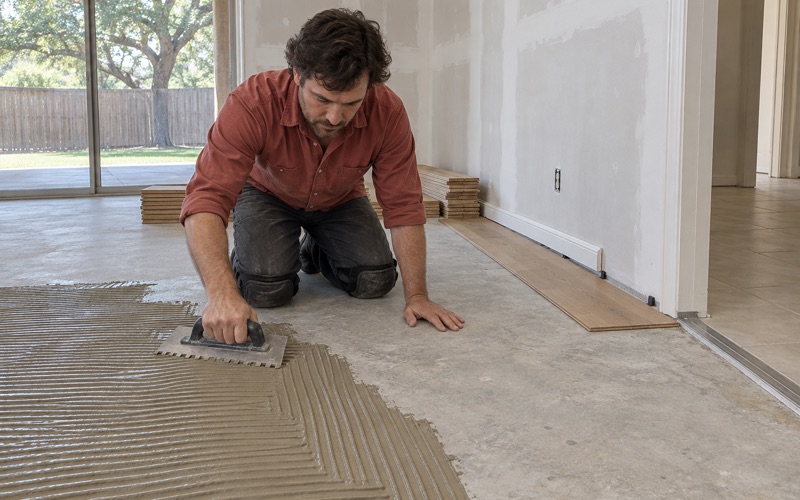
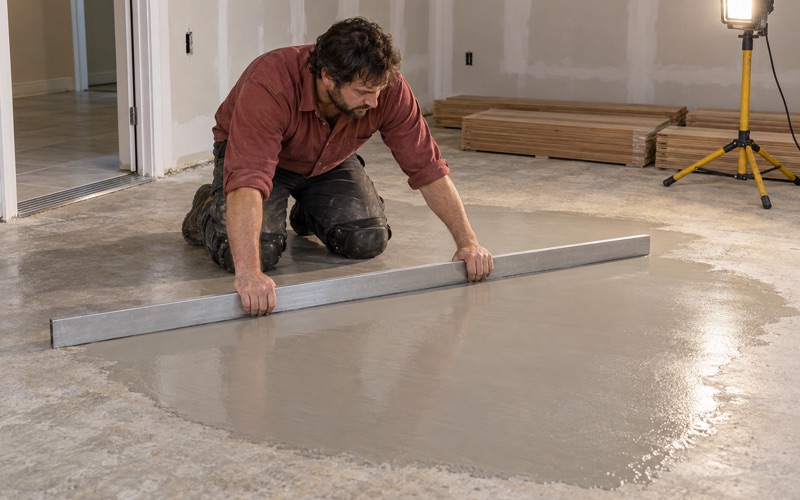
Flatness comes first. We check the slab against the subfloor flatness tolerance the installation method requires and correct it by concrete grinding or self-leveling underlayment before material is delivered, because a long run telegraphs a dish in the slab as hollow spots and squeak.
Moisture testing happens before an installation date is set, not after the boards are on site. Depending on the assembly that means an ASTM F2170 in-situ relative humidity test, a calcium chloride test, or pinless moisture meter readings on the wood itself, and the boards acclimate inside your house rather than in a garage.
Expansive clay subsoil under these slabs shrinks and swells with the season. A post-tension slab is stiffer, but stiffness does not stop soil movement, so doming and dishing still reach the finish floor as cupping, gapping and squeak that return in the same places year after year. Where foundation work is planned, we sequence behind it instead of laying a floor over ground that is still moving.
Finish choice, cure time and getting your rooms back
On an occupied job the finish is a scheduling decision as much as an appearance one. What you are really buying is the number of nights you spend somewhere else, or in the wrong end of your own house.
Waterborne against oil-modified polyurethane
Waterborne polyurethane returns a room to light use fastest and stays clear rather than ambering, which keeps white oak looking like white oak. Oil-modified polyurethane costs more days on the calendar and adds a warmth that suits red oak, and some households want exactly that.
Neither is fully cured the day you walk on it. We give you the light-traffic date, the rugs-and-furniture date and the full-cure date as three separate numbers, because they are three different numbers, and treating them as one is how a new floor picks up its first mark.
Hardwax oil and the repair you can make yourself
Hardwax oil sits in the wood rather than over it. It asks for more maintenance and pays that back in spot repair: a scuffed patch can be cleaned and re-oiled in place instead of recoating a whole room, which is worth real money in a house nobody is moving out of.
Sheen level and the traffic this city puts on a floor
A lower sheen level hides dust, pet prints and the fine scratching that a glossier floor shows under a window. On the larger parcels, where horse keeping and other semi-rural uses persist, boots and dogs come through the same door every day of the week. We detail the entry and mudroom transitions for that wear and pick a sheen that does not advertise it.
Refinishing a 1970s floor, and knowing when one is finished
Colleyville incorporated on January 10, 1956, and most of what stands here was built long afterward: 84.44% of the housing stock is post-1980. That makes the 1,143 units built in the 1970s a distinct minority, carrying problems the newer stock has not reached yet.
Those houses predate post-tensioned slab construction and are now approaching or past fifty years old. Their original oak floors have usually been sanded before, sometimes more than once, and the question is never whether they can be made to look good. It is whether enough wood is left to do it with.
Measuring the wear layer before we quote
We measure the remaining wear layer thickness before a refinish is priced, not after the first pass has already spent it. On a solid hardwood floor that means reading thickness at a vent cut, a threshold or a lifted board; on engineered hardwood it means knowing the veneer above the tongue.
That number decides what is possible. With room above the tongue there is a full sand and a fresh grit sequence available; close to it there is one light pass and no second chance; below it, sanding is removal rather than restoration, and you should hear that before you have paid for it.
The repair ladder, priced honestly
If a screen and recoat will get you where you want to be, we will tell you so instead of selling a full sand. A buffer, a fresh coat and a single day is a different job from three days of dust, and on a floor with a thin wear layer it is also the only job that does not shorten what is left of the floor.
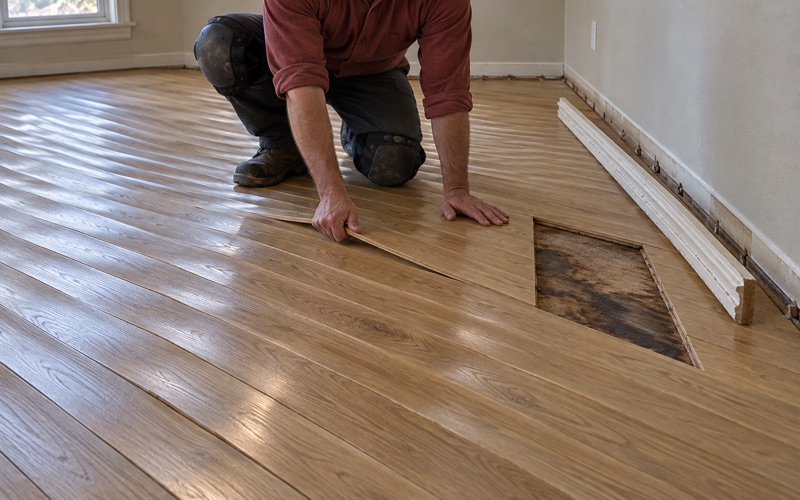
Damage below the finish moves up the ladder: board replacement where a run is gouged, a dutchman patch where a fixture or a register left a hole, a weave-in repair where new boards have to disappear into an old floor. Each is quoted as what it is, in a written scope, before work starts.
When a floor cannot be sanded again
A floor at the end of its sanding life is not a failure. It is a floor that did its work for fifty years. At that point the honest options are replacement in solid hardwood, or engineered hardwood where slab moisture or the height at your doorways argues for it.
We will lay out what each one costs in dollars and in days out of your rooms, and if the existing floor has one careful refinish left in it we will say that as well. In a house you are living in, the right answer is often to take that last refinish now and plan the replacement for a year you choose.
- 20+ Years on Wood Floors
- Dustless Sanding and Containment
- Written Scope Before Work Starts