Flower Mound Wood Flooring installs, sands and refinishes wood flooring in Corinth, and we have been doing this work for more than twenty years. The last two decades of that have been spent on North Texas slabs rather than somewhere else, which is the part that matters when a floor has to sit flat and stay flat here.
Our work in the city splits three ways: new installation over slab, sanding and refinishing of floors already down, and repair work that runs from a single board to a whole room. We price the repair-depth ladder honestly — if a screen and recoat will get your floors where you want them, we will tell you so rather than sell you a full sand.
Every job starts with a written scope, so the price is not discovered halfway through. We test the slab for moisture before an installation date is set rather than after the boards are on site, and one crew stays on your house from the first day to the last, so the sanding is never handed to a subcontractor.
Corinth’s Three-Decade Build and Your Floor’s Age

Corinth did not grow in separated waves. It went up in one long push, and that single fact shapes almost every flooring decision made inside the city limits today. Where your house sits in that run tells us more about what your floors need than the year on the deed does.
The Unbroken 1980-2009 Run
Of the 8,869 housing units in Corinth, 7,303 — 82.3% — were built across three consecutive decades, from 1980 through 2009. The 1980s account for 1,526 units, the 1990s for 3,269, and the 2000s for 2,508. Only 196 units, 2.2%, predate 1970, and just 133 have gone up since 2020.
That means the original flooring across most of the city is somewhere between sixteen and forty-five years old and aging on the same clock. When we walk two houses on opposite sides of town, we are usually looking at the same generation of product with the same number of years on it.
Floors from the 1990s Peak
The 1990s alone put 3,269 units on the ground, 36.9% of everything in Corinth, and that decade’s flooring is what we see most often. Solid red oak and white oak strip, frequently two and a quarter inches wide, sometimes site-finished and sometimes prefinished with a factory bevel.
A solid floor from that era usually has sand left in it, and what we measure first is how much. The depth from the surface to the top of the tongue decides whether a full grit sequence is available or whether a screen and recoat is the honest answer.
Engineered Floors from the 2000s Half of the Run
The 2000s added 2,508 units, 28.3% of the city, and that stretch is where engineered hardwood starts appearing on Corinth slabs in volume. On a slab-on-grade house it was frequently the sensible answer at the time, and a glue-down engineered floor from those years is now twenty to twenty-five years into its service life.
Engineered floors do not offer a solid floor’s second chance, and wear layer thickness sets the ceiling. A thick sawn-face wear layer will take a full sand; a thin rotary-peeled one will not, and a screen and recoat becomes the only refinishing worth attempting. We measure that before we quote a sand, because the difference decides whether you are refinishing or replacing.
When Refinishing and Replacement Arrive Together
Because the stock aged together, the decisions arrive together. A street where every house was framed inside the same eighteen months tends to reach the end of its finish life in the same couple of years, and neighbors start comparing quotes across fences.
We would rather you decide on the condition of your own floor than on what happened next door. Wear layer thickness on an engineered floor, and remaining sand depth on a solid one, are measurements rather than opinions, and we take them before we price anything.
Looking for wood-flooring closer to Lake Dallas? See Wood-Flooring Services in Lake Dallas.
Rental Turnover and Attached-Unit Work
Corinth reads as an owner-occupied city, and mostly it is: 6,550 of 8,540 occupied units are owner-occupied, 76.7% of the total. The remainder is still a real share of the work we do here, and it is a genuinely different job.
Landlord-Directed Turnover
1,990 occupied units in Corinth are renter-occupied. Turnover flooring runs on a schedule set by a lease end rather than by a remodel, so the binding constraint is almost always the calendar instead of the specification.
We plan those jobs backward from the date the unit has to be ready, cure time included. Waterborne polyurethane returns a rental to service faster; oil-modified polyurethane builds an ambering warmth that owners of older red oak often want kept.
Attached Units and Other Structure Types
7,528 of the city’s 8,869 units — 84.9% — are single-family detached, which leaves 1,341 units in other structure types. Attached product carries its own constraints: shared walls, sound requirements, and a floor assembly that frequently rules out a nail-down installation.
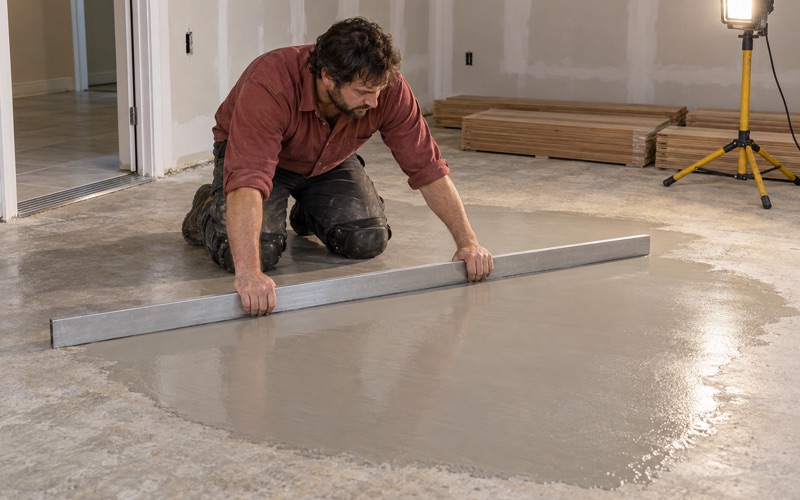
Glue-down and floating installations both work in those buildings when the subfloor cooperates. We check subfloor flatness tolerance first, correct it with concrete grinding or self-leveling underlayment, and detail the transitions with T-molding and reducers instead of filling a gap.
Detached Homes and Whole-House Work
The 6,492 owner-occupied single-family detached homes are where most of our sanding work happens, and they tend to be whole-house jobs — living areas, halls, stairs and often the bedrooms in a single run.
Stairs are close to their own trade inside that job. Stair treads, risers and stair nosing have to match the field boards in species, sheen level and stain, and they absorb more traffic than anything else in the house.
Codes, Registration and Access in Corinth
Who signs the work off, and how we reach the job, are both local questions. We work to the code edition your town has actually adopted rather than a generic national one, and we find that out before we quote.
The Code Editions Corinth Has Adopted
The City of Corinth operates under the 2021 International Building Code family, including the mechanical, plumbing and fire codes, and has adopted the 2020 National Electrical Code. Plan review and inspections run through the City of Corinth Building Services Division.
Residential flooring is not usually a permitted trade in itself, but the jobs it touches often are. When a floor follows a plumbing repair or an electrical change, the sequence has to respect those inspections, and we schedule around them rather than through them.
Contractor Registration and the City List
Contractors register through the Corinth Civic Access Portal. That takes an account, plus a color copy of the driver’s license, the trade license where applicable, and a certificate of insurance emailed to permits@cityofcorinth.com. The city maintains a Corinth Area Registered Contractor List from those registrations.
It is a short process and worth asking about before anyone starts work in your house. A contractor who cannot say plainly where they stand with the city is telling you something useful.
The Lake Cities Corridor and I-35E
Corinth is one of the four Lake Cities on Lewisville Lake, and Interstate 35E cuts the city north to south. That corridor is the practical access spine for job sites here, and it is how our crew, our machines and your boards all arrive.
It matters for delivery windows on larger orders, and for staging a whole-house job in phases. Property records for the city sit with the Denton Central Appraisal District, which is worth knowing if you are timing a floor to a sale.
Wood Flooring Services in Corinth
This is the actual work, and how we approach each part of it in a Corinth house. The order we do things in matters at least as much as the product we put down.
Installation Over a Corinth Slab
Denton County soils mapping shows fine sandy loam and loamy fine sand through the Corinth area, inside the Eastern Cross Timbers band rather than deep black prairie clay. That does not make a slab inert, and we treat every slab as a moisture source until it has been measured.
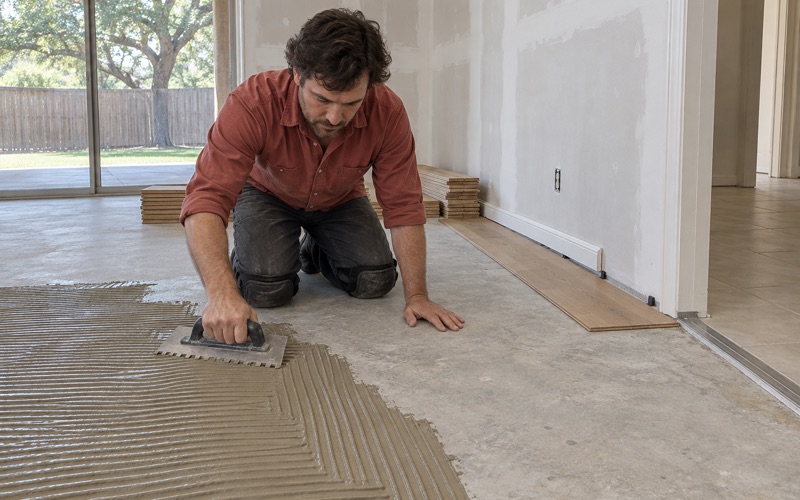
We run an ASTM F2170 in-situ relative humidity test, a calcium chloride test or a pinless moisture meter as the assembly requires, then specify the vapor retarder from the reading. Boards acclimate inside your house before one is fastened down, we leave a proper expansion gap at every wall, and on a post-tension slab we never fasten into the deck.
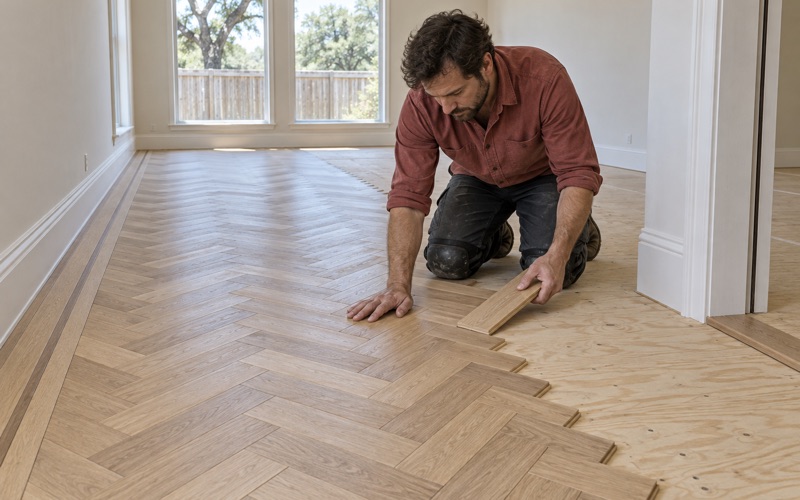
The fastening method follows the assembly rather than a preference. Nail-down over plywood takes flooring cleats or flooring staples at the correct fastener crown width, glue-down goes direct to a prepared slab, and a floating installation earns its place where the slab cannot be trusted to stay dry through a season.
Species, Plank Width and Hardness
Red oak is the default in houses of this vintage and it is what most Corinth refinishing work turns out to be. White oak reads cooler and takes a reactive stain differently, while hickory sits higher on the Janka hardness rating and brings far more color variation from board to board than either oak does.
Plank width is the other decision, and it changes the installation rather than only the look. Wider boards move more across a season, so they want a tighter moisture window, a longer acclimation and a closer fastener schedule on a nail-down job. We would rather talk that through at the quote than explain seasonal gapping in your second winter.
Sanding and Refinishing
Sanding is dustless with containment, and the rest of the house is sealed off from the work area. Furniture goes out and comes back, and the room is left clean at the end of each day rather than at the end of the job.
The machines work in sequence: drum sander across the field, edger at the perimeter, orbital sander to blend, buffer for the final screen. A skipped grit shows up under the low sheen levels most homeowners are choosing now, and the finish itself — waterborne polyurethane, oil-modified polyurethane or hardwax oil — is a separate decision we walk through before the sander comes out.
Repairs, Water Damage and Board Replacement
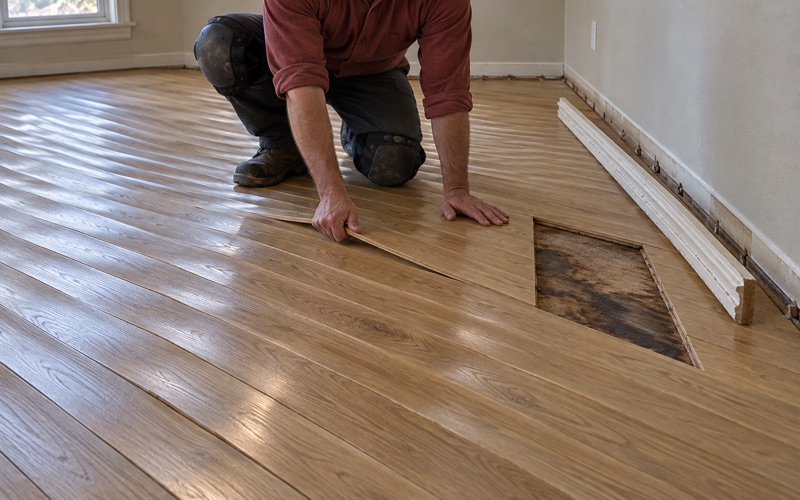
Not every floor needs a full sand. Board replacement, a weave-in repair or a dutchman patch can save a section, and lacing new boards into the existing field is what keeps the fix from reading as a rectangle in the middle of the room.
Cupping, crowning, buckling and seasonal gapping are symptoms rather than the problem, so we find the moisture source first. Water damage jobs come with the documentation a claim needs — dated photographs, moisture readings and an itemized scope — and we sequence around foundation work and plumbing repairs instead of laying a floor over a slab that is still moving.
- 20+ Years on Wood Floors
- Dustless Sanding and Containment
- Written Scope Before Work Starts