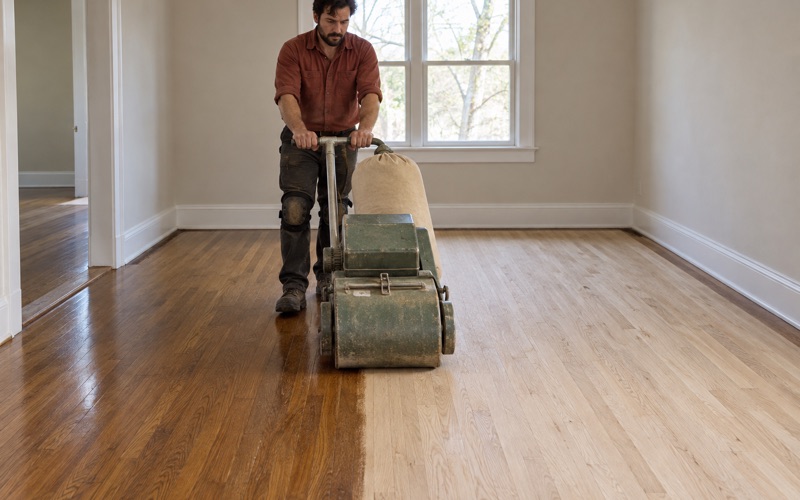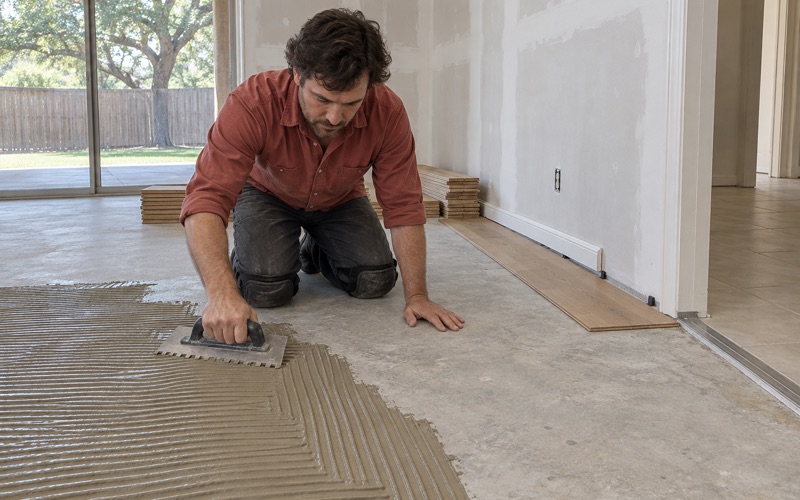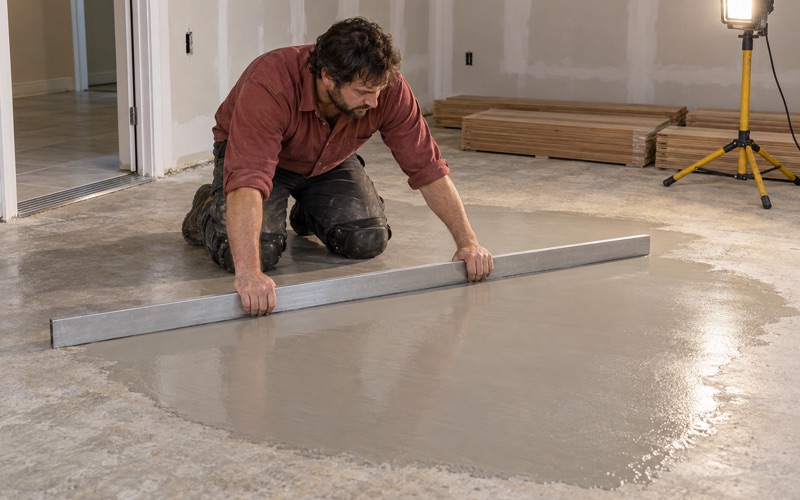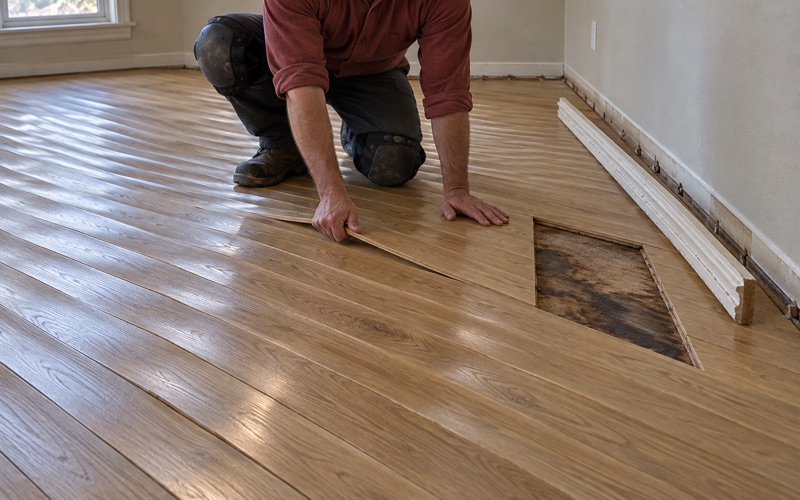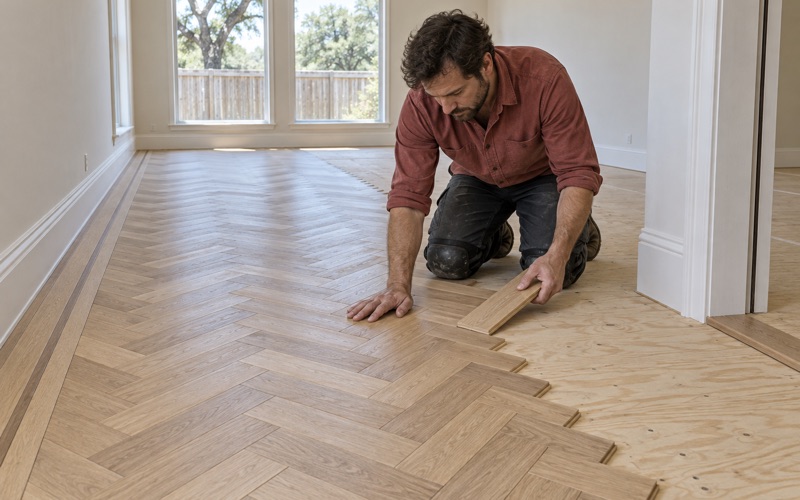
Flower Mound Wood Flooring has been doing hardwood floor installation in Denton for more than twenty years, and we treat this city as its own problem rather than a repeat of the last subdivision. A good share of the work here starts underneath an existing floor instead of on top of a clean pour. What we find down there decides the price, the method and the calendar.
That makes the first visit a diagnostic one. We open a closet corner, read the build-up layer by layer, and put a pinless moisture meter on whatever is hiding under the carpet before anybody quotes a square-foot number. A written scope comes out of that visit, so the price is not discovered halfway through the job.
We also price the repair-depth ladder honestly. If a screen and recoat will get a floor through another decade, we say so rather than sell a full sand, and when boards genuinely have to come up we show you why. One crew runs the work from the first day to the last, and the sanding is never handed off.
The stock that predates the slab era
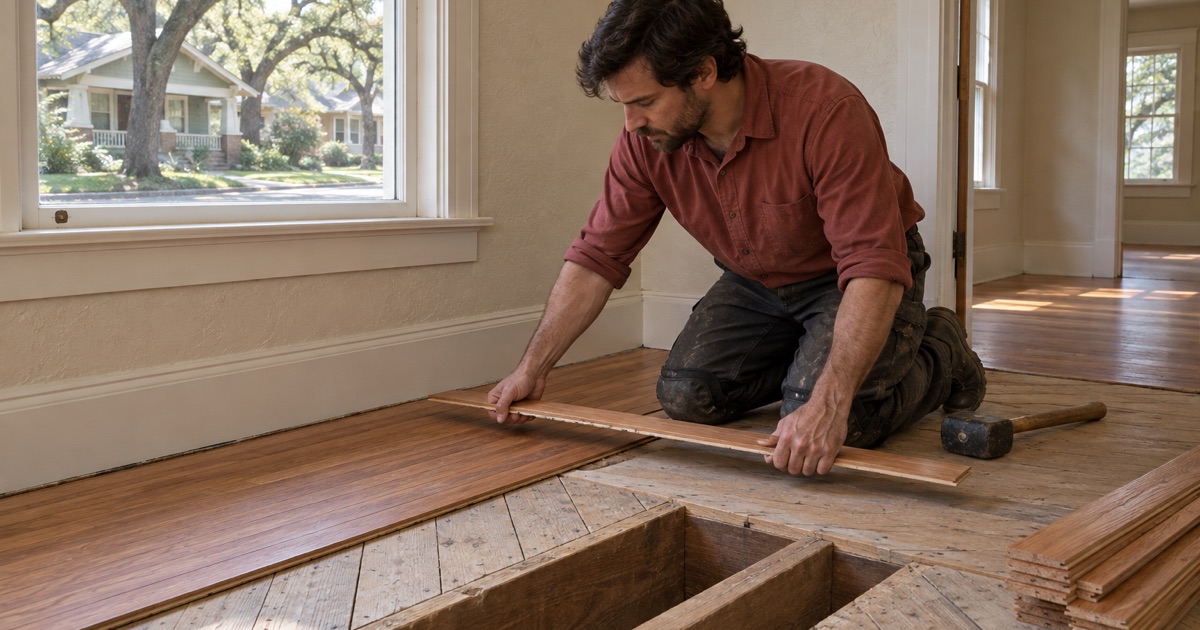
Most of Denton is modern: 73.12% of its 60,531 housing units were built in 1980 or later, and the 2000s alone account for 13,217 of them. But 2,981 units predate 1950, and 1,414 of those went up in 1939 or earlier. That older fraction is where the demanding flooring work lives.
Reading the build-up before anyone quotes
On a house from that era there is often something original under the carpet or the sheet vinyl: tongue-and-groove strip oak or pine, nailed down rather than glued. We do not assume it is there and we do not assume its condition. A small inspection opening in a closet tells us how many layers went on top and how much material is left.
Wear layer thickness decides everything after that. A strip floor with enough wood above the tongue can take a full grit sequence on a drum sander; one that has already been sanded three times is a candidate for board replacement in the worn lanes instead of another pass. Measuring it takes ten minutes and settles an argument that otherwise gets had halfway through the sanding.
Establishing how the floor is actually supported
Whether a given Denton house sits on a raised pier-and-beam system or on concrete is something we establish on site. There is no parcel-level foundation record to look up beforehand, and the age of a house does not settle it on its own, so we look rather than guess.
The answer changes the method completely. A raised subfloor takes nail-down installation with flooring cleats and a fastener crown width matched to the plank, while concrete pushes the job toward a glue-down or floating installation and a moisture test regime before an install date is set at all. On the slab side of that fork we test first and schedule second, using an in-situ relative humidity test or a calcium chloride test rather than a hand on the floor.
What the original oak is worth keeping
Old strip flooring in this stock is usually narrow red oak, and it is frequently worth saving. Where boards are split, scorched near an old heater, or missing along the line of a removed wall, a weave-in repair or a dutchman patch laced into the field beats replacing a whole room. Salvaged boards lifted from a closet floor are the best match available, because nothing milled this year has aged the same way.
Where a floor has to be extended into an enclosed porch or a later bathroom, we match species and plank width first and sheen level second. White oak and hickory read differently beside hundred-year-old red oak, and their Janka hardness numbers are not interchangeable when the two have to wear at the same rate.
Looking for wood-flooring closer to The Colony? See Wood-Flooring in The Colony.
Working inside a designated historic district
Denton has three local historic districts covering more than 80 acres on the city’s west and north sides. A house inside one of those boundaries picks up a review step that a house three blocks outside it does not have. We build that step into the schedule rather than discover it midway through.
What actually triggers a review
Interior finish is usually not the issue. What draws attention is anything visible from the street: a porch floor, an entry threshold, or a front door that has to be trimmed because a new build-up height raised the finished floor a quarter inch. A T-molding or a reducer at a doorway sounds like a trim detail right up until it lands where the public can see it.
The City of Denton Historic Landmark Commission and the city’s Historic Preservation Officer handle that side of it. Where we can, we design the build-up so the door and thresholds stay exactly as they are, which keeps a flooring job from turning into an exterior alteration nobody asked for.
Oak-Hickory and its Craftsman houses
The Oak-Hickory Historic District holds a large collection of Craftsman homes around the 1924 senior high campus, and Craftsman plans come with details a careless crew ruins quickly. Built-in cabinetry sits down on the finish floor, stair runs are narrow, and small rooms meet at thresholds that were never meant to move.
We cut in around fixed casework with an edger and a buffer instead of pulling it out, and we scope stair treads, risers and stair nosing separately because they are their own trade within the job. Quarter round is a last resort here, not a default trim. Where an expansion gap has to be hidden along a wall, the base shoe that was already there is usually the honest answer.
Bell Avenue, designated in 2019
The Bell Avenue Historic District was adopted in 2019 and covers a three-block stretch of North Bell Avenue with 28 buildings, a mix of Craftsman bungalows and Ranch-style homes. It is a young designation over old houses, so some owners along it are meeting the review process for the first time.
We keep our side of that simple: dated photographs before anything starts, a scope that states plainly what changes and what does not, and the finish specification in writing. Nothing visible from the sidewalk changes unless it is an explicit line in the scope.
Crawl-space moisture and movement underfoot
On a raised floor system, most of what looks like a finish problem is a structural one. Bounce underfoot, a dip that runs with the joists, and a soft patch near an exterior wall are all reporting on what is beneath the boards rather than on the polyurethane above them. Reading those signals correctly is the difference between a floor that lasts twenty years and one that looks wrong again by the second summer.
Deflection, joist spacing and a failed pier
We measure deflection across the span and check joist spacing before anyone talks about sheen. A sagging run over a failed pier telegraphs straight back through brand-new material, and sanding a floor that sits on a moving structure buys one season and then charges for the whole job twice.
Where the structure needs attention first, we sequence around it. The same holds for plumbing repairs and foundation work: we would rather wait out another trade than fasten a floor to something that has not finished moving.
Moisture rising from an unconditioned crawl space
An unconditioned crawl space is a moisture source a house on concrete simply does not have. Denton sits in NWS public forecast zone TXZ103, and the swing between a humid spring and a dry winter shows up in the boards as cupping in one season and seasonal gapping in the next.
So we take readings from below as well as above, subfloor and finish boards both, and we let material acclimate inside the house in the room it will occupy before a single board is fastened. Expansion gaps get sized against the range we measured, not a number off a chart.
Why movement gets read address by address
Part of Denton sits on the Eastern Cross Timbers, whose sandy and sandy loam soils derive from sandstone parent material and drain well; the city recognizes that upland habitat as environmentally sensitive. Farther east in Denton County the ground turns to Blackland Prairie clay, which behaves nothing like it through a dry summer.
That line does not follow neighborhood boundaries, so we do not infer a foundation story from a spot on a map. We read the floor in front of us and the movement it has already recorded. Two houses a few streets apart can want different answers about subfloor flatness tolerance, and pretending otherwise is how a flat-looking quote turns into a callback.
Codes, rentals and the campus calendar
The University of North Texas and Texas Woman’s University both sit in Denton, and their calendars govern a large share of the city’s housing. Owner and renter households here are exactly even at 28,332 apiece out of 56,664 occupied units, and roughly 8,000 detached single-family houses are rented rather than owner-occupied.
The window between move-out and move-in
Near the two campuses, older single-family houses are commonly run as student rentals, sometimes let by the room. On those the only realistic time to sand, coat and cure a floor is the stretch between spring move-out and fall move-in, with nobody living on top of the work.
That window is short and every other property in the same belt wants it. We book it early, stage material so acclimation happens inside the window instead of eating it, and match the finish to the turnover date: waterborne polyurethane where the floor has to be walked on soon, oil-modified polyurethane or hardwax oil where there is time to spare.
Refinishing against a turnover date
A house that has been split or let by the room takes wear a family home does not. Chair-leg gouging concentrates around desks, one traffic lane goes bare while the rest of the room looks new, and the damage is rarely spread evenly enough to justify replacing everything.
We answer refinish-versus-replace with the same ladder we use anywhere. A screen and recoat run with an orbital sander carries a tired but sound floor through another lease, while a full sand is for boards with the wear layer left to justify it. Where a water leak is behind the damage, the scope goes out itemized with dated photographs and moisture readings, because a claim needs documentation and a landlord needs a number.
The code edition Denton has actually adopted
Denton adopted the 2021 International Building Codes, and every permit applied for on or after June 1, 2022 has to meet them; the adopted amendments cover the 2021 IRC alongside the 2020 NEC and the 2021 IECC, IMC, IPC, IFC and IFGC. Residential inspections run through the Building Safety Division on the city’s eTRAKiT portal.
We work to the edition this city has adopted rather than a generic national one, and we follow NWFA installation guidelines for the flooring itself. On pre-1978 houses the EPA RRP lead-safe rule shapes how the work is contained, which sits naturally with the dustless sanding and sealed-off work areas we run everywhere, along with moving your furniture out and back and leaving the room clean each evening.
- 20+ Years on Wood Floors
- Dustless Sanding and Containment
- Written Scope Before Work Starts