Flower Mound Wood Flooring has been installing, sanding and repairing wood flooring in Farmers Branch for more than twenty years, and that whole run has been spent on North Texas slabs rather than on basements and floor joists somewhere else. A wood floor here is a concrete problem before it is a wood problem. We test for moisture before an installation date goes on the calendar, not after the boards are sitting in the garage.
What makes this city unusual is that we work in two housing eras with almost nothing between them. Roughly half the addresses we quote sit in construction poured before post-tension slab work was normal, and the other half sit in buildings that went up after 2010. The floor that belongs in one is rarely the floor that belongs in the other.
So the first conversation is usually about your build year rather than about species or sheen level. Once we know which side of that divide your address falls on, the moisture testing, the subfloor prep and the repair-depth ladder all follow from it. You get a written scope before anyone starts, so the price is not discovered halfway through the job.
Two Farmers Branches, fifty years apart

The build-year record for this city has a shape you can see at a glance. Of 17,260 total housing units, 5,209 went up in the 1950s and 1960s and 6,816 have gone up since 2010, while the entire twenty years from 1980 through 1999 produced 1,791 (ACS 2024 five-year, table B25034). We move between two building eras about fifty years apart, with very little stock in between.
The 1950s and 1960s core
Of that older core, 2,126 units date to the 1950s and another 3,083 to the 1960s. The stock of that period was built on conventionally reinforced slab-on-grade, an era predating post-tension slab construction, and it carries the narrow-strip hardwood, subfloor and trim details of its day. Only 13.2% of the city’s units predate 1960, so the 1960s half of that core is the larger one.
When we are called to one of these houses, the question is almost never whether there is wood under the carpet. It is how much wear layer thickness is left after sixty years and two or three previous refinishes, and what our own readings say about the substrate once we are inside.
The twenty-year gap
Between 1980 and 1999 this city added 1,791 units in total, 1,017 in the 1980s and 774 in the 1990s. For an inner-ring suburb that is close to a standstill, and it means the flooring era most crews in this region cut their teeth on is barely represented here. We rarely walk into the 1990s tract layout with a plywood subfloor and a builder-grade red oak strip floor.
The practical effect is that experience transfers less smoothly here than it looks like it should. A crew fluent in 1990s construction has to reach back fifty years or forward fifteen, and the two ends want different fasteners, different subfloor prep and different finishes.
The wave after 2010
The other half of the curve is recent: 5,193 units were built in the 2010s and another 1,623 in 2020 or later. Much of that arrived as multifamily, and it shows in the tenure split, with 9,100 of 15,810 occupied units renter-occupied and 42.5% of the housing stock single-family detached.
For us that means a steady mix of owner work in the mid-century houses and unit-by-unit work in newer buildings. The two jobs share a species list and share very little else, because access, scheduling and dust containment all change with the building.
Looking for wood-flooring closer to Providence Village? See Providence Village Wood-Flooring.
Original hardwood in a mid-century house
The best floor in one of these houses is often the one already there. Builders of that period laid narrow-strip hardwood over the subfloor details of the day, and boards of that vintage are usually solid hardwood with real thickness left in them. Before we quote a replacement, we find out what survives.
What sixty-year-old narrow strip looks like
Original 1950s and 1960s floors are typically two-and-a-quarter-inch red oak or white oak in a tight strip pattern, often under a finish that has gone amber with age. What we measure first is the wear layer thickness above the tongue, because that number decides whether a full sand is even available to you. Seasonal gapping, a few cupped boards near an old leak and scattered dutchman patches from previous repairs are normal and rarely fatal.
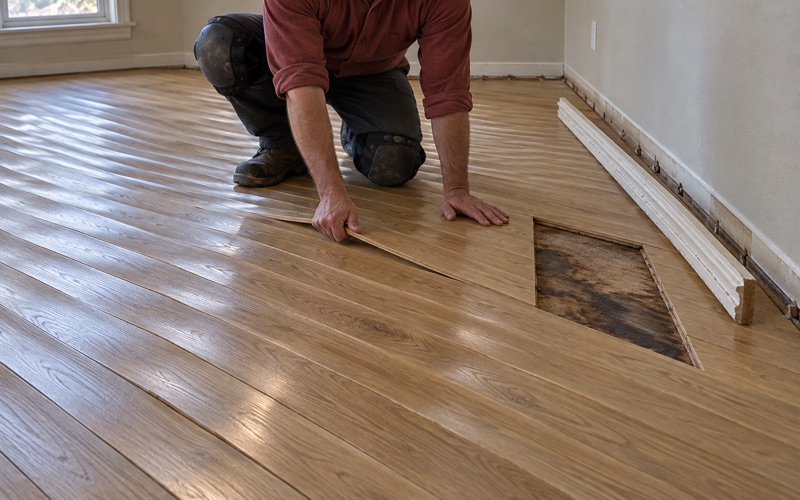
Where boards are missing or damaged, we prefer a weave-in repair or selective board replacement over a patch that reads as a rectangle. Matching sixty-year-old red oak takes some hunting, but lacing new boards into the existing field is what keeps a floor looking original rather than repaired.
Screen and recoat before a full sand
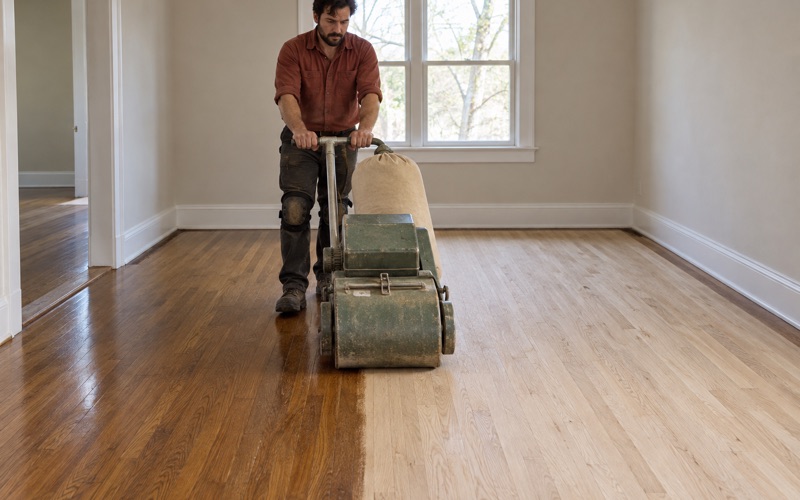
A full sand costs wear layer thickness you cannot get back, and on a floor this old you may have only one left. If the damage is in the finish rather than in the wood, a screen and recoat with waterborne polyurethane resets the sheen level for a fraction of the price and none of the thickness. We will tell you when that is the right call instead of selling you the deeper job.
When a full sand is genuinely warranted, we run a proper grit sequence with a drum sander, edger and buffer, under dustless containment with the rest of the house sealed off from the work area. One crew does the whole thing from the first day to the last, and the sanding never goes to a subcontractor.
Moisture, and what the ground does here
Dallas County lies largely within the Blackland Prairie, developed on the Eagle Ford Shale, whose montmorillonite content produces differential swell and contraction reported at up to seven inches and known to cause foundation and roadway problems. That is why we sequence around foundation work and plumbing repairs rather than laying a floor over a slab that is still moving.
For an installation over concrete we run an ASTM F2170 in-situ relative humidity test, or a calcium chloride test where that suits the job better, and we check the wood itself with a pinless moisture meter. If the readings say a vapor retarder is needed before anything is glued or fastened, that goes into the scope before a date is set.
Floors in the Mustang Station district
The station area is the clearest expression of the newer half of the curve. DART Green Line light rail platforms at Farmers Branch opened in December 2010, the first phase of Mustang Station, 257 apartments, opened in 2013 just east of the station, and the Shops at Mustang serve the same area. Mid-rise apartments and walkable retail have been filling in around it since.
Engineered hardwood over newer construction
In post-2010 buildings we specify engineered hardwood far more often than solid. A quality engineered plank with a thick wear layer handles a concrete environment better, tolerates a wider plank width without as much seasonal movement, and can still be sanded once or twice depending on that wear layer. White oak dominates current requests, and hickory comes up when a household wants the higher Janka hardness rating.
Solid hardwood is not off the table in a newer ground-floor unit, but it changes the preparation. Fastening solid strip over concrete means building up a subfloor first, and that spends ceiling height and threshold transitions in a way most owners would rather avoid.
Glue-down, floating and nail-down
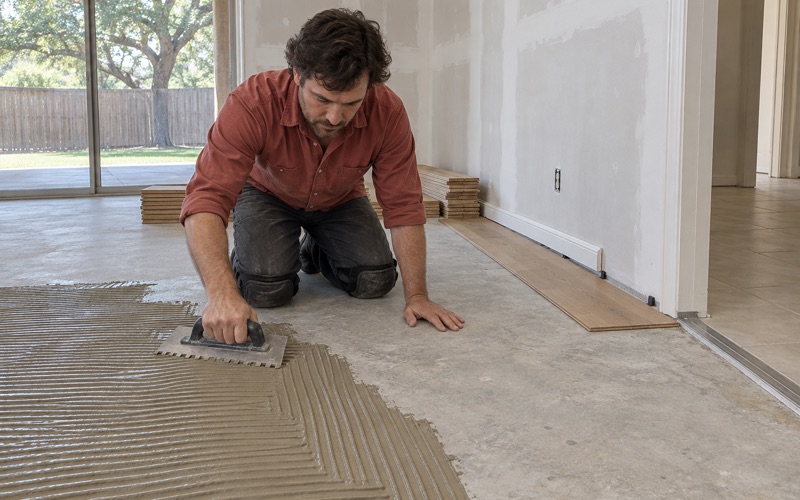
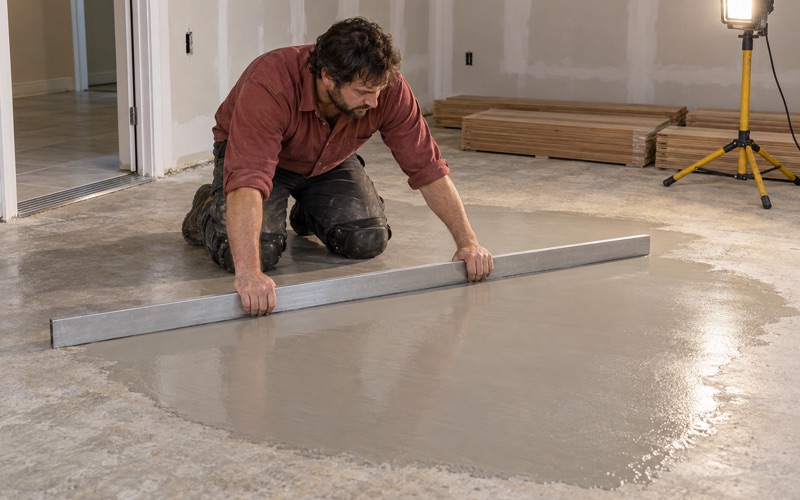
Method follows the building rather than the preference. Glue-down installation gives the most solid underfoot feel over concrete and needs a flat substrate, which usually means concrete grinding or self-leveling underlayment to bring the surface inside subfloor flatness tolerance. Floating installation is faster and more forgiving over an imperfect substrate, and in an upper-floor unit it is often what the building’s own flooring rules ask for.
Where there is a wood subfloor, we nail down with the right flooring cleats or flooring staples and the correct fastener crown width for the plank. Whichever method we use, we leave a real expansion gap at the perimeter and let the boards acclimate inside the unit before a single one is fastened.
The code edition the city actually enforces
We work to the code edition your town has adopted, not a generic national one. This city has enforced the 2018 International Code Council construction codes with city amendments, approved by City Council in December 2019 and enacted January 1, 2020, and the City of Farmers Branch Community Services Department is the building code authority for the work.
A package of ordinances adopting the 2024 ICC model construction codes, numbered 3943 through 3953, was placed on the City Council agenda as a study-session item on August 19, 2025. The Legistar record for that item, printed September 13, 2026, records no final action, so the 2018 package still governs. City staff describe the proposed amendments as reflecting North Texas Council of Governments regional recommendations and addressing local construction conditions.
Which of the two Farmers Branches is your address in?
Nearly everything above turns on one number, and it is a number you can look up. The build year on the Dallas Central Appraisal District record for your parcel tells us which era we are working in before we ever walk the house.
Start with the build year
If the record says 1955 or 1968, we arrive prepared to find original narrow-strip hardwood under carpet and to talk about whether a screen and recoat gets you where you want to be. If it says 2014, the conversation is about engineered plank, substrate flatness and how the building handles deliveries, elevators and dust.
Houses from the thin middle of the curve exist here, just not many, and they get their own read on site. We do not assume a construction detail from a build year alone: the record tells us what to expect, and the moisture readings and the subfloor tell us what is actually there.
Two eras, two different scopes
On the mid-century side, most of the budget goes into repair depth, meaning how much sanding the floor can still take, how many boards need weaving in, and what the finish should be. Oil-modified polyurethane gives the warmer amber tone many of these floors carried originally, while waterborne polyurethane keeps the color closer to raw and cures faster. Hardwax oil is the third option when an owner wants a matte, spot-repairable surface.
On the newer side, most of the budget goes into preparation and logistics: flattening the substrate, protecting corridors and elevators, and sequencing around the rest of the building. Transitions carry more weight there as well, since T-molding, reducer and stair nosing details are what make a unit read as finished rather than assembled.
What we put in writing
Our written scope lists the moisture test results, the preparation, the installation method, the species and the finish, so the price is settled before the first day rather than discovered in the middle of it. Furniture goes out and comes back, and the room is left clean at the end of each working day.
Water damage jobs come with the documentation a claim needs: dated photographs, moisture readings and an itemized scope. Whichever of the two Farmers Branches your address sits in, the same crew stays on it from the first day to the last.
- 20+ Years on Wood Floors
- Dustless Sanding and Containment
- Written Scope Before Work Starts