Flower Mound Wood Flooring installs, refinishes and repairs wood flooring in Grapevine, and we have been doing this work for more than twenty years — the last two decades of it on North Texas houses. That experience matters more here than it would in most towns, because the floor under the carpet is genuinely not predictable from the address.
A single working day for us can begin on an original framed floor in the historic core and end on a slab poured in the 1980s. Subfloor type, fastening method and moisture testing all change between those two, and nothing about the street tells you which one you are standing on until someone opens it up and looks.
So every job starts with a written scope, and the price is settled in it rather than discovered halfway through. We test moisture before an installation date goes on the calendar, boards acclimate inside your house before a single one is fastened down, and one crew stays on the job from the first day to the last.
Working inside Grapevine’s historic districts
The historic core plays by rules the surrounding subdivisions do not. The city adopted a Historic Preservation Ordinance in 1991 and created the Historic Preservation Commission to administer it, and if your property sits inside one of the districts that followed, the review calendar becomes part of your project schedule.
Six local districts, each created by ordinance
The local districts were adopted one at a time: the Commercial Historic District (Ordinances 92-39 and 92-67), College Street (93-58), the Historic Grapevine Township District (98-41, extended by 2011-62), Cotton Belt Railroad (2002-12), West Wall Street (2004-41) and the D. E. Box Addition (2011-58). Six districts, six sets of design guidelines.
Which one an address falls inside is the first thing we check on a quote in the core. It decides whether any part of the job needs review, and how far ahead of a start date we need to be standing. We would rather learn that during the estimate than the week the material is due to arrive.
The pre-construction meeting that comes before the permit
A documented pre-construction meeting is required before a building permit is issued for any property inside the boundary of the Historic Grapevine Township, and for all designated landmark properties. That is a real scheduling constraint rather than a formality, and it simply does not exist a few streets away in the subdivisions.
We build it into the sequence instead of treating it as a delay. Where flooring is one part of a larger permitted renovation, that meeting sets the earliest honest start date, and we would rather quote you the date we can hold than a cheerful one we cannot.
A Certificate of Appropriateness for exterior work
Any exterior alteration to a building or property within one of the city’s historic districts, or to a designated historic landmark, requires a Certificate of Appropriateness from the Historic Preservation Commission, and the work must conform to the applicable design guidelines. The Commission provides that review at no charge to the property owner.
Interior flooring usually sits outside that review, but the boundary is not always where owners assume it is. A porch deck, an exterior threshold or a stair that reads from the street can pull part of a floor job back into it, so we flag the question in the written scope rather than guessing at it.
Looking for wood-flooring closer to Corinth? See Wood-Flooring in Corinth.
Original framed floors in the College Street district
College Street’s residences date from about 1865 to about 1949, Bungalow and Prairie Style houses among them, which puts nearly all of them ahead of the region’s conversion to slab-on-grade building. Under those floors are joists and a crawl space, not concrete.
What is usually under the carpet
651 of Grapevine’s 22,885 housing units were built before 1960 — 127 of them in 1939 or earlier, and another 102 during the 1940s. That is a modest share of the city by percentage and a substantial number of houses by count, so original site-finished solid hardwood hiding beneath later floor coverings is a realistic find here rather than a curiosity.
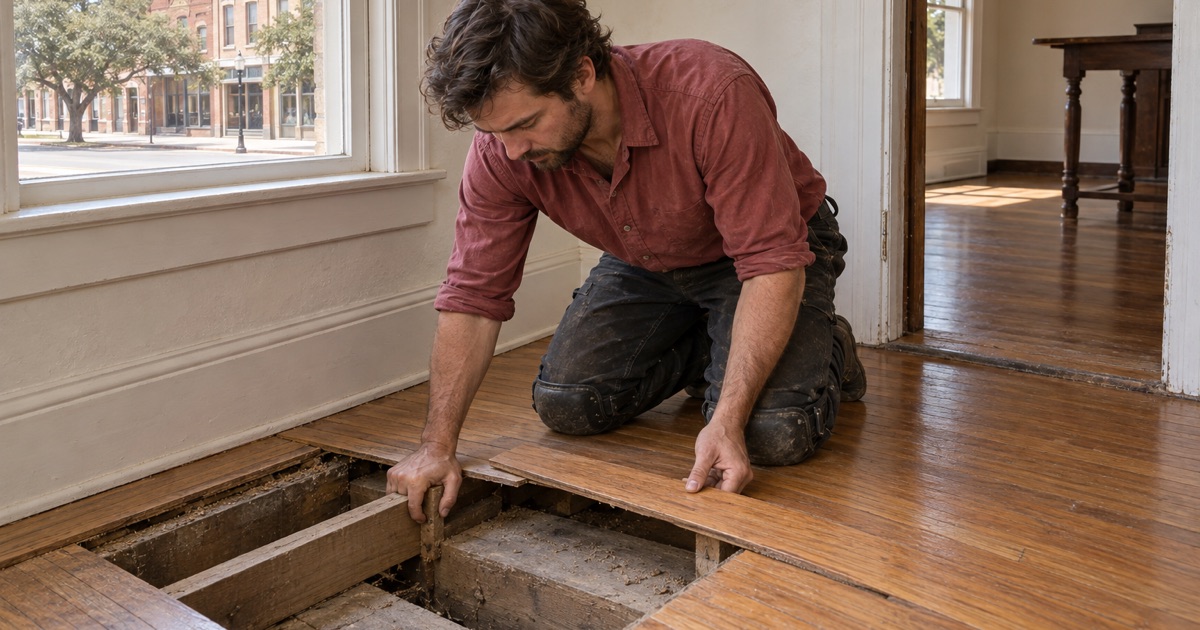
We lift a closet corner or a register cutout and look before anyone commits to a plan. Original tongue-and-groove pine or oak with sound material left above the tongue is worth saving, and establishing that early can turn a full installation into a refinish at a fraction of the cost.
Crawl-space moisture, cut nails and structural sag
Framed floors bring conditions a slab never produces: seasonal gapping as humidity swings, cupping where moisture rises from below, cut nails that fight a drum sander, and structural sag that a new floor will telegraph rather than hide. We read the assembly with a pinless moisture meter before planning anything on the surface.
Where deflection is structural we say so and sequence around it. Fastening a floor to a frame that is still moving is how a good-looking installation becomes a callback eighteen months later, and losing a week on the schedule is the cheaper of the two outcomes.
Repair before replacement
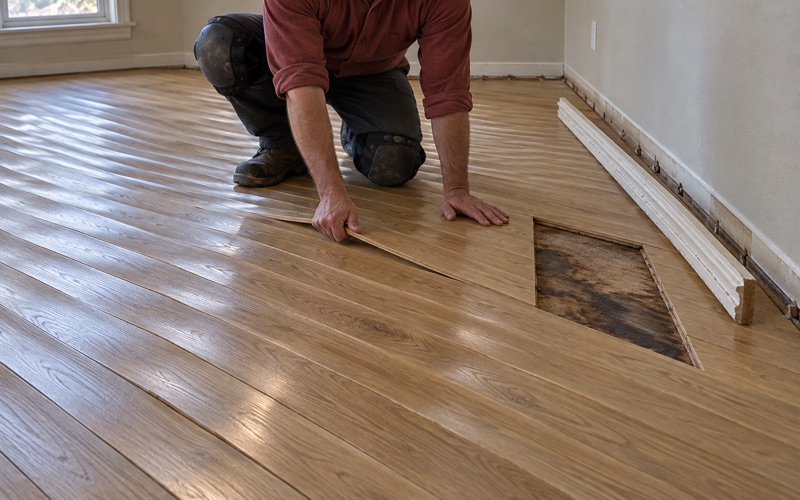
On a floor this old the honest answer is usually less work, not more. A dutchman patch, a weave-in repair, or board replacement laced into the surrounding field keeps original material in the house, and a screen and recoat will sometimes deliver what an owner arrived expecting a full sand to deliver.
We price that ladder plainly and tell you where your floor actually sits on it. Houses of this vintage also fall under the EPA RRP lead-safe rule, so containment and clean-up are set up for it from the first morning rather than bolted on when somebody raises the question.
The 1980s and 1990s subdivisions: slab-on-grade work
Most of Grapevine is not historic. 6,617 units — 28.9% of the housing stock — went up during the 1980s, the largest single decade in the city, and 53.70% of all units are single-family detached. Those are slabs, and slabs are a separate discipline.
Testing the slab before a date is set
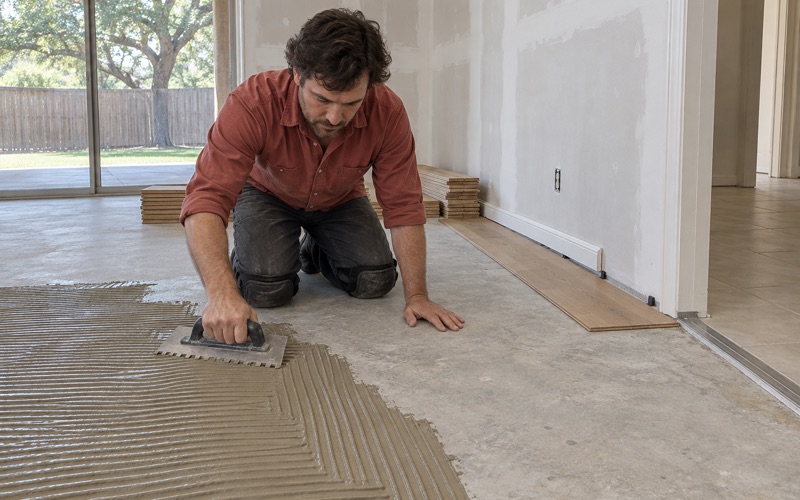
Moisture testing happens before an installation date is set, never after the material is stacked in the living room. Depending on the assembly that means an ASTM F2170 in-situ relative humidity test, a calcium chloride test, or both, and the readings decide whether a vapor retarder or a different installation method belongs in the scope.
A slab that reads wet is not a reason to walk away from the job; it is a reason to change the plan. What we will not do is glue an engineered floor down onto a slab whose numbers say it will be pushing moisture into that adhesive for the next two years.
Flatness, grinding and self-leveling underlayment
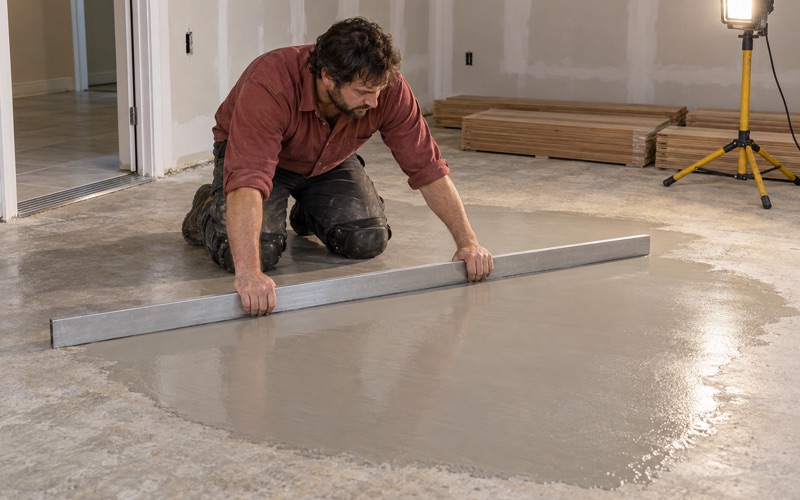
Subfloor flatness tolerance is where most slab installations are quietly won or lost. High spots come down with concrete grinding, low spots come up with self-leveling underlayment, and both happen before the first board goes down rather than after somebody finds a hollow spot underfoot.
Post-tension slabs are common at the newer end of the city and they change what may be fastened into. We identify the assembly first, then choose glue-down, floating or nail-down over a suitable subfloor with the right cleats or staples, instead of defaulting to whichever method is fastest that week.
Foundation and plumbing work come first
North Texas slabs move, and the remedy belongs ahead of the floor. When foundation work or a plumbing repair is planned or recently finished, we sequence around it rather than laying hardwood over concrete that has not settled into its final shape yet.
That sometimes makes us the last trade in the house instead of the convenient one. It also means the expansion gap at the perimeter is sized for a floor that will move seasonally, then covered with quarter round, a reducer or a T-molding at every transition.
Installation, refinishing and repair across the whole city
Whichever half of the city your house belongs to, the finishing work is where a floor takes on its character. We do the sanding ourselves — it is never handed to a subcontractor — and the dustless containment goes up before equipment comes off the truck.
Grit sequence, sheen level and the finish you choose
A full grit sequence with the drum sander, an edger for the perimeter and a buffer to blend the two is what makes a floor read flat under raking light. Skipping a grit saves an hour on site and shows up permanently in the finished surface, so we do not skip one.
The finish is then a decision rather than a default. Waterborne polyurethane returns the room to service quickly and stays clear, oil-modified polyurethane brings amber depth and a longer cure, and hardwax oil gives a repairable low-sheen surface. We settle sheen level with a sample in the actual room and its actual light.
Species, plank width and what suits the house
White oak, red oak and hickory all behave differently once they are down, and the Janka hardness rating is only part of that story. Plank width drives how much seasonal movement you will see, and on engineered hardwood the wear layer thickness decides how many refinishes the floor still has in it.
In an older house we try to match species and width to what is already there, so a repair disappears into the field instead of announcing itself. In a 1990s house the question is wide open, and we would rather help you choose carefully once than replace a floor that never suited the room.
Main Street tenant spaces and rental turnovers
The commercial core is a market of its own. The Grapevine Commercial Historic District runs 300-530 S. Main Street across 8.5 acres, and tenant floors inside those buildings absorb traffic, spills and a refinishing schedule no house ever sees, usually within a closing window measured in days.
Nearly half of the city’s occupied housing is renter-occupied — 10,211 of 21,593 occupied units — so turnover work runs steadily alongside owner renovations. Both reward a screen and recoat done on time over a full sand done late, and we schedule around the tenant instead of asking the tenant to schedule around us.
Codes, documentation and the end of each day
We work to the code edition Grapevine has actually adopted rather than a generic national one. The city took up the 2021 International Building, Residential, Plumbing, Mechanical, Fuel Gas and Fire Codes, together with the 2020 National Electric Code, effective January 1, 2024, and permitted work here is measured against those.
Water damage jobs leave with the documentation a claim needs: dated photographs, moisture readings and an itemized scope. On every job the furniture goes out and comes back, the rest of the house stays sealed off from the work area, and the room is left clean at the end of each day.
- 20+ Years on Wood Floors
- Dustless Sanding and Containment
- Written Scope Before Work Starts