Flower Mound Wood Flooring installs, sands and refinishes wood flooring in Highland Village, and more than twenty years of that work has been done on North Texas slabs rather than somewhere else. We handle solid and engineered hardwood, refinishing, stairs and repair. Every job opens with a written scope, so the price is not discovered halfway through.
Most of what we are called out for in this city is not a new floor. It is a floor that already exists — often under carpet, often original to the house — and a homeowner deciding whether it can be brought back or has to come out. That question has an answer, and the answer is available before anyone signs anything.
So we test the slab for moisture before an installation date is set rather than after the boards arrive, and we price the repair-depth ladder honestly. If a screen and recoat will do what you want, we will tell you that instead of selling a full sand. When a full sand genuinely is the right call, we explain what it buys you.
Highland Village Homes Built Before 1990
The founding cohort, and how old it is now
Highland Village incorporated on February 14, 1963 and counted 516 residents in 1970. The build-out that followed arrived with the DFW International Airport growth era, and the housing stock still shows it: 941 units, 16.6 percent of the city, date to 1970-1979, and 2,156 units — 38.0 percent — predate 1990 (ACS 2024 5-year, table B25034).
That puts the largest pre-1990 group somewhere between thirty-six and fifty-five years old. A house that age is rarely a candidate for its first refinish. It is on its second or third, and how much floor is left to work with becomes the whole conversation.
The 1980s added another 1,215 units, 21.4 percent of the city, and only 130 homes here predate 1970 at all. This is not an old town with a scattering of newer construction. It is one long build-out whose earliest and largest phases are reaching the same maintenance decision within a few years of one another.
How much wear layer is left
Solid strip flooring is finite. Each sanding removes a fraction of a millimeter on the way down toward the tongue, and a floor that has already been through the process twice has less margin than its owner assumes. We measure remaining wear layer thickness where the loss is worst — thresholds, the kitchen approach, the top stair tread — rather than in the middle of a quiet bedroom.
Where there is depth left, a full sand with a proper grit sequence returns a floor that looks new and can be done again in a decade. Where there is not, we say so and talk about board replacement or a new floor instead of sanding down to the fasteners.
The repair-depth ladder, quoted in order
Not every tired floor needs a drum sander. A screen and recoat abrades the existing finish with a buffer and lays a fresh coat over the top, which answers dulling and light scuffing at a fraction of the cost and in a fraction of the time.
Above that sits a full sand, and above that partial board replacement or a fresh installation. We quote those rungs in order and tell you honestly which one your floor is on. Twenty years of this work in North Texas is mostly knowing where a floor sits on that ladder.
Looking for wood-flooring closer to Trophy Club? See Trophy Club Wood-Flooring.
What Is Under a 1970s Highland Village Floor
Original oak under carpet
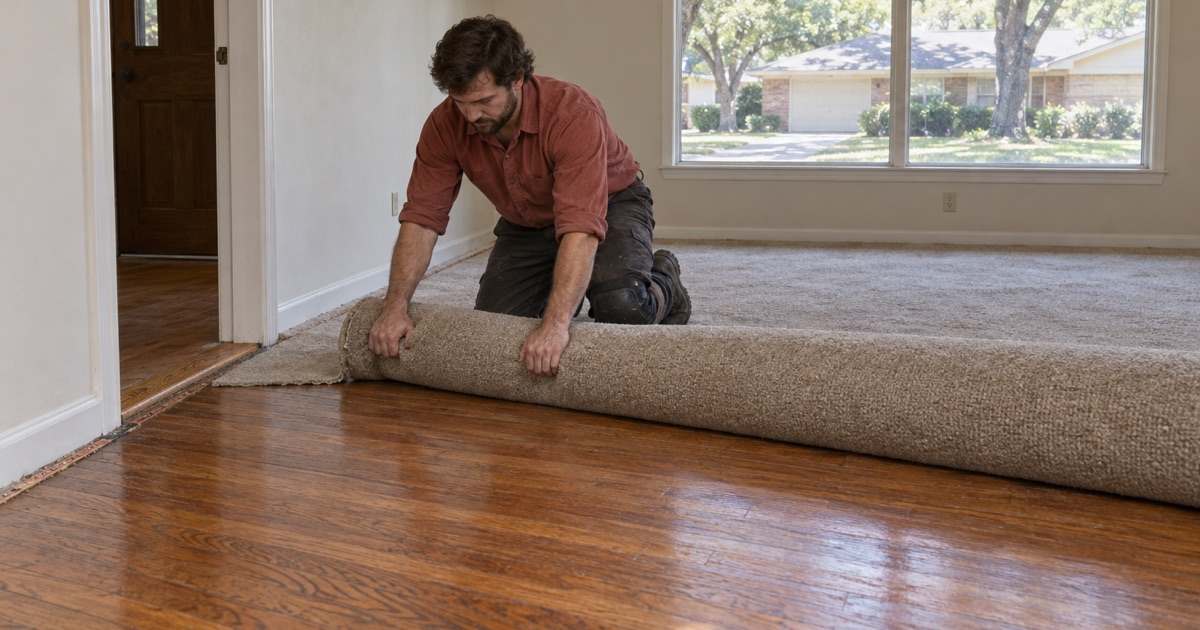
The most common find in this city’s older subdivisions is solid red oak strip flooring hiding under carpet that went down in the 1980s or 1990s. It is frequently in better shape than anyone expects, because carpet and pad shielded it from sun and traffic for thirty years.
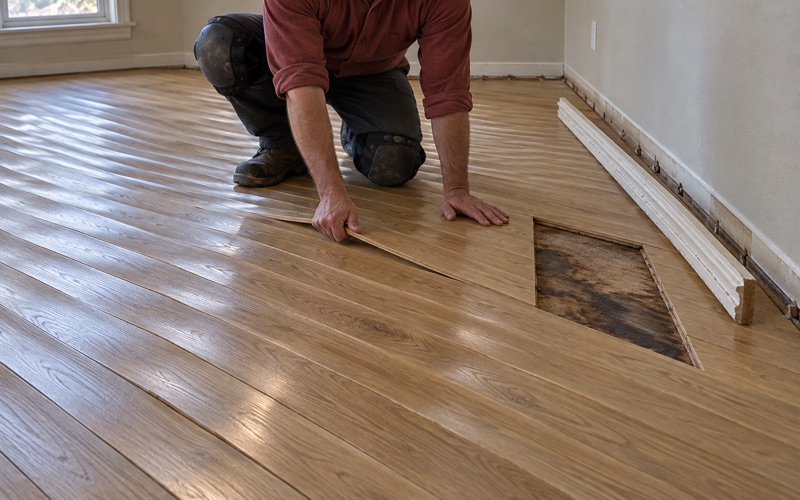
What it needs is usually tack strip holes filled at the perimeter, staples pulled, and attention at the seams where a floor register or a doorway was cut in. We lift a corner and look before quoting, because the carpet is concealing either a windfall or a patched subfloor.
Once it is uncovered the decisions get ordinary: whether to keep the narrow strip look or move to a wider plank, and what color the wood will actually take. Red oak reads pink under a light finish and white oak reads browner, so we sample stain on your own floor in your own light rather than handing you a chip.
Slab and subfloor conditions after fifty years
Five decades is long enough for a slab to move, for a supply leak to have come and gone, and for someone to have covered a problem rather than repair it. Before an installation date exists we run moisture testing — ASTM F2170 in-situ relative humidity probes in concrete, or a pinless moisture meter across a wood subfloor — and we check the surface against flatness tolerance.
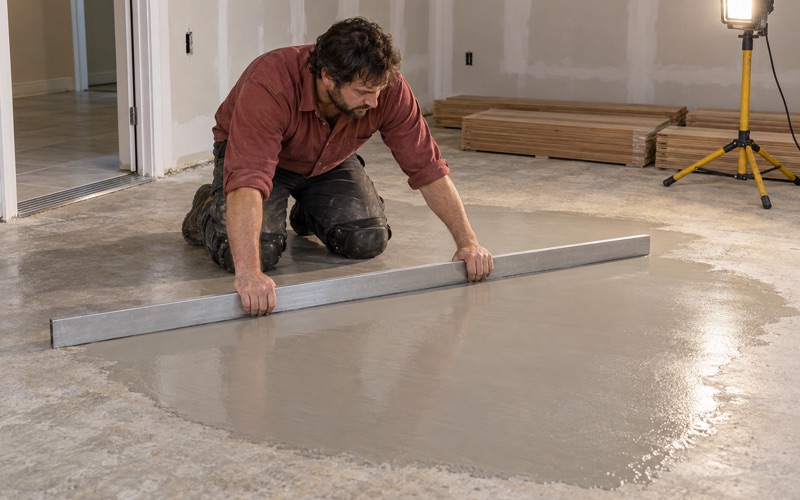
Where a slab is out, the answer is concrete grinding on the high spots and self-leveling underlayment in the low ones, never thicker adhesive. We also sequence around foundation work and plumbing repairs instead of laying a floor over a slab that is still moving.
Lake-facing lots and the ground under them
The city sits on the south side of the far western branch of Lewisville Lake, so a meaningful share of lots fall away toward the water with real grade change between the street and the rear elevation. Indoors that becomes split levels, stepped rooms and stair runs a floor has to negotiate cleanly.
The ground here belongs to the Eastern Cross Timbers band: fine sandy loam and loamy fine sand over Cretaceous Woodbine and Trinity strata, per Denton County soils mapping. Sandy soils behave differently beneath a slab than a heavy expansive soil does, which is worth knowing before anyone assumes the cause of a hump in a hallway.
The 1990s And 2000s Additions
The newer half of the housing stock
The other side of this city is considerably younger: 1,592 units, 28.0 percent, went up between 1990 and 1999, with another 1,146 through the 2000s. These are slab-on-grade houses, and what they were originally finished with was mostly carpet, tile, or an early engineered product.
Engineered hardwood remains the usual answer over a slab, glued down or floated above a vapor retarder, and the specification that matters most is wear layer thickness — that number decides whether the floor can ever be sanded. We explain what you are buying before anyone picks a color.
Permits and the code edition this city has adopted
Highland Village requires a permit before any new construction, addition, alteration or repair of existing buildings and structures. The published residential examples run to new windows and doors, patio covers, garages, fireplaces, water heaters, siding replacement and roof replacement; floor covering and interior finish are not named either way.
The adopted codes are the 2015 International Mechanical, Plumbing, Energy Conservation and Existing Building Codes as amended, alongside the 2014 National Electrical Code as amended. We work to the edition your city has actually adopted rather than a generic national one, and we ask City of Highland Village Building Inspections rather than guess when a job touches something adjacent.
Where two eras meet in one house
Houses that have been added onto — and plenty here have — end up with an original floor meeting a newer one at a doorway. Sometimes that junction is a transition: a T-molding, a reducer where the heights differ, a stair nosing at a step down, quarter round at the perimeter.
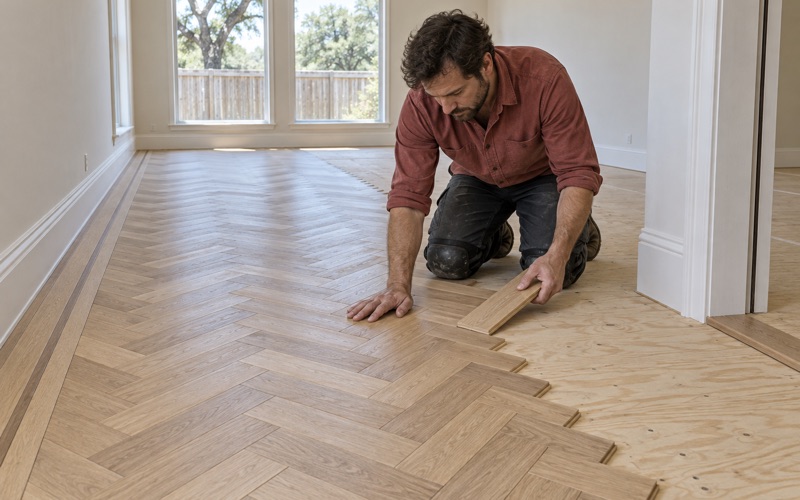
Sometimes it should not be a transition at all. Lacing new boards into the old field, or a weave-in repair where a wall came out, makes two runs read as one floor. That costs more than a strip of molding and is usually the right call in a main sightline, so we show you both and let you decide.
Wood Flooring Services In Highland Village
Installation, from acclimation to the last board
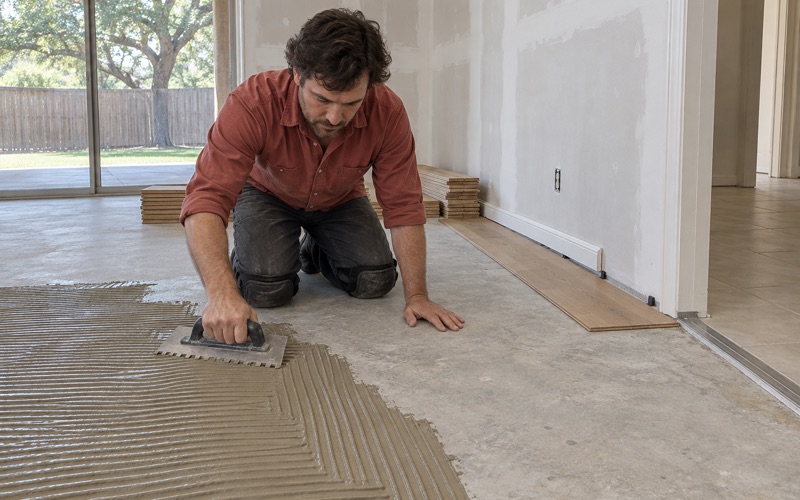
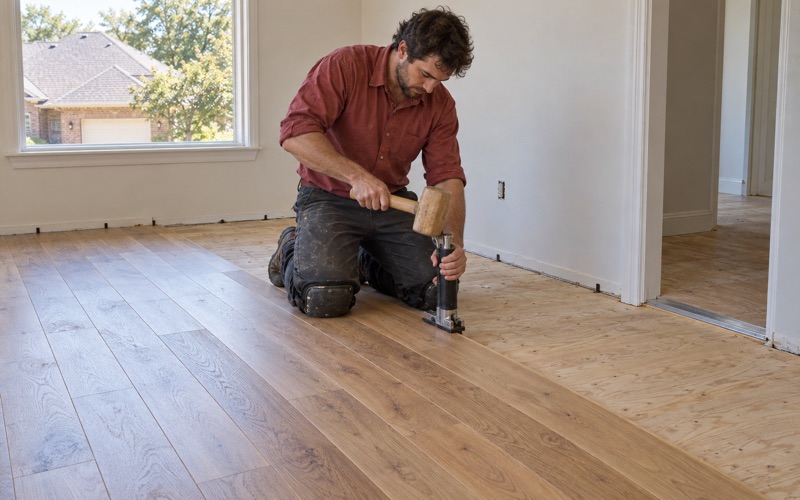
We install solid and engineered hardwood — white oak, red oak and hickory most often — and we will walk you through Janka hardness ratings and plank width against how the room actually gets used. Nail-down over a wood subfloor with the correct cleats or staples, glue-down or floating over slab.
Boards acclimate inside your house before a single one is fastened, and we hold a proper expansion gap at every wall and vertical surface. Skipping either step is how a floor ends up cupping or buckling in its first humid season, and that is not repairable afterward without taking it apart.
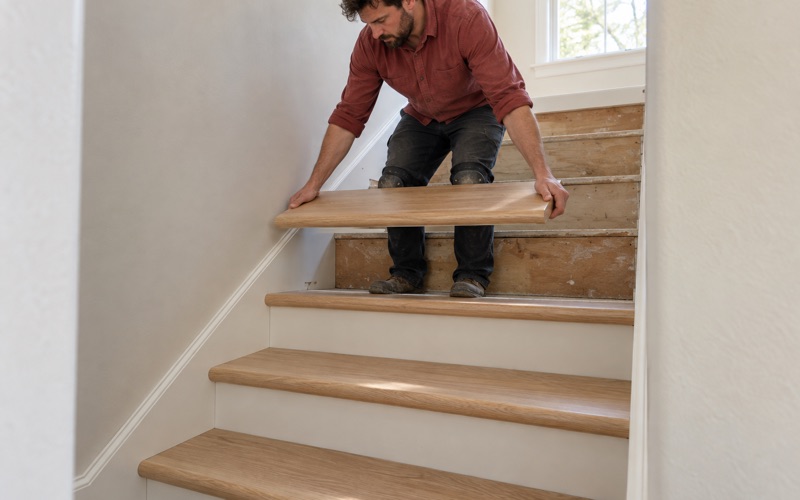
Stairs run on their own schedule. Each stair tread and riser is cut and fitted individually, the nosing has to line up with the floor it meets at the landing, and the run is finished after the field so the color carries through. It is the slowest part of most jobs and the first thing a visitor looks at.
Sanding and refinishing
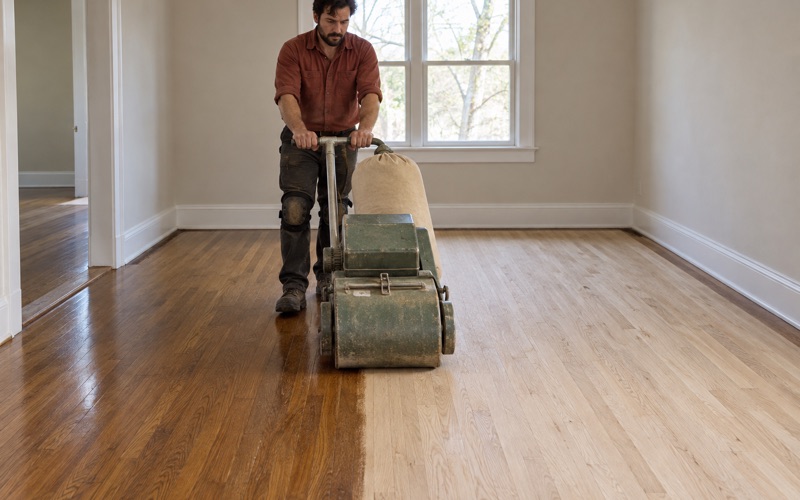
Refinishing runs a full grit sequence: a drum sander through the field, an edger at the walls, a buffer to blend, so the floor reads flat under raking light instead of showing dish marks. Our sanding is dustless with containment, and the rest of the house is sealed off from the work area.
Then you choose a finish. Waterborne polyurethane cures fast with low odor, oil-modified polyurethane brings warmth and depth, and hardwax oil gives a matte surface that can be spot-repaired. Sheen level decides how much a floor shows dust and dog traffic, which matters more day to day than most people expect.
Repairs and water damage in an occupied house
This is a homeowner market: 95.9 percent of units are single-family detached and 91.9 percent of occupied units are owner-occupied. There is effectively no landlord or property-manager channel here and almost no attached-unit sound work, so nearly every job is a family deciding about their own house and living in it while we work.
That shapes how we run it. One crew from the first day to the last, with the sanding never handed to a subcontractor, furniture moved out and put back, and rooms left clean at the end of each day. Water damage work comes with dated photographs, moisture readings and an itemized scope for the claim.
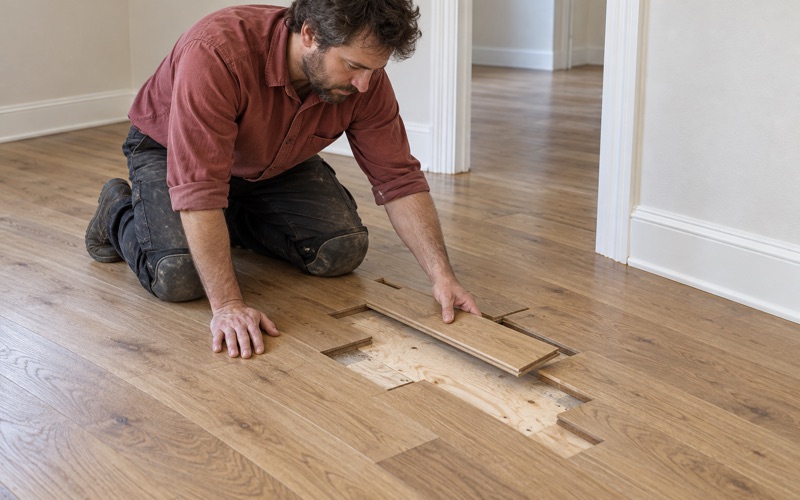
Repairs themselves stay as small as the damage allows. A dutchman patch lifts out a localized defect, board replacement handles a damaged run, and matching species and plank width to what is already down is most of that work, since a floor bought in 1975 is rarely still in production. We would rather patch one well than sell you a floor you do not need.
- 20+ Years on Wood Floors
- Dustless Sanding and Containment
- Written Scope Before Work Starts