Flower Mound Wood Flooring has been installing engineered hardwood flooring in Irving for more than twenty years, and the last two decades of that work has been spent on North Texas slabs rather than somewhere else. Engineered hardwood is the format that suits a slab-on-grade house, because a plywood or hardwood core moves less across the grain than a solid board of the same width. That structural difference matters more here than the species or the stain color does.
The reason we quote Irving addresses one at a time is that no two of them describe the same building. A cottage near the original town plat and a house in a master-planned community share a city and a code official, and almost nothing else about how a floor gets installed.
So the rest of this page is organized around that split. We cover what changes in the older housing stock, what changes in the newer, and how the city’s own inspection program affects you if the address is a unit you manage rather than a home you live in.
Two Irvings inside one city boundary
Irving holds 102,512 housing units, and the way they were built divides cleanly in two. About 64.1% went up in 1980 or later, while 11,365 predate 1960 and 925 predate 1940. That older stock sits in and around the original townsite rather than spread evenly across the city.
The 1903 town plat and the Heritage District
The Heritage District is that original plat. Co-founders J.O. Schulze and Otis Brown, surveying a Chicago, Rock Island & Gulf Railway route, bought 80 acres from the Britain family in 1902 and sold the first town lots at public auction on December 19, 1903. The houses that filled in around those lots over the following decades are the ones we approach most carefully.
Heritage Park still holds the Heritage House, built in 1912 by C.P. Schulze, who ran the Irving Lumber Company from 1905 to 1957 and was the brother of co-founder J.O. Schulze; it was designated a Texas State Historical Landmark in 1986. The park also keeps the Caster Cabin of 1887 and a replica of the 1903 Rock Island Depot. That era of construction is less a museum exhibit here than a description of the surrounding blocks.
Las Colinas, master-planned from 1972
Las Colinas was developed beginning in 1972 by Ben H. Carpenter on his family’s former cattle ranch, originally covering more than 12,000 acres, and was among the first planned communities in the United States. It contains 25 million square feet of office space, 1.3 million square feet of retail and 3,400 single-family homes, along with apartment complexes and a canal offering gondola cruises.
To a flooring crew that inventory reads as a different building type altogether. Slab-on-grade houses, residential floors stacked inside towers, and leased units with a management company standing between us and the resident each impose their own limits on scheduling, access and adhesive choice.
One code official for both halves
Both halves answer to the City of Irving Inspections Division. Irving adopted the 2021 International Residential Code with local amendments, including Appendices AA, AB, AC, AH and AT, and the 2024 International Building Code as its commercial building code. Ordinance 2026-11253, adopted March 26, 2026, repealed the former Chapter 8B in connection with that 2024 I-Code adoption, so applications submitted on or after its effective date are reviewed under the 2024 I-Codes with Irving amendments. We work to the edition a town has actually adopted rather than a generic national one, which matters most on a job that reaches a stair rebuild or structural subfloor repair rather than a floor covering alone.
Looking for wood-flooring closer to Little Elm? See Wood-Flooring in Little Elm.
Wood floors in Irving’s pre-1960 housing
The 11,365 units built before 1960 are where the surprises live, and 925 of them predate 1940 outright. A house of that age has usually been re-floored at least once, sometimes over a structural wood subfloor and sometimes over a slab poured for a later addition. We price those two conditions separately because they are two different jobs.
Reading the subfloor before anything is ordered
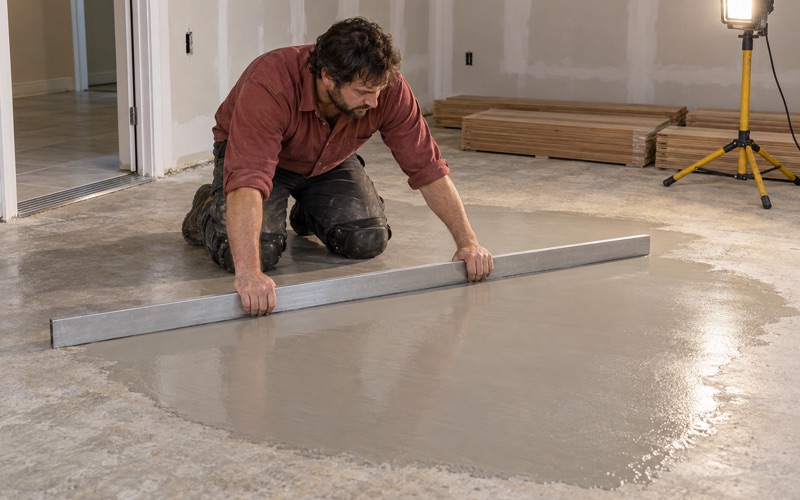
An engineered floor is only as flat as what it lands on, so subfloor flatness tolerance is the first thing we measure in an older house. Where a floor has settled we correct it with concrete grinding on a high spot or self-leveling underlayment in a low one, and that correction goes into the written scope rather than surfacing on install day.
Additions from different decades also tend to change level at a doorway. A T-molding, a reducer or a lacing cut into the existing field is a decision to make in advance, and we agree on it with you before any boards arrive.
Moisture testing that happens before the date is set
We test the slab for moisture before an installation date is set, not after the boards are on site. Depending on the substrate that means an ASTM F2170 in-situ relative humidity test, a calcium chloride test, or a pinless moisture meter across a wood subfloor. A vapor retarder is then specified against the reading rather than out of habit.
Boards acclimate inside your house before a single one is fastened down. We size the expansion gap to the plank width and the room, because seasonal gapping, cupping and crowning are all far cheaper to prevent than to repair.
Repair depth, priced honestly
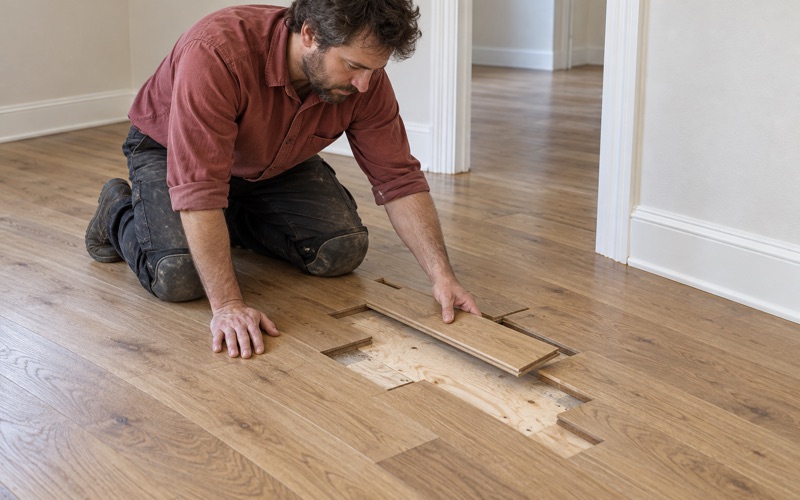
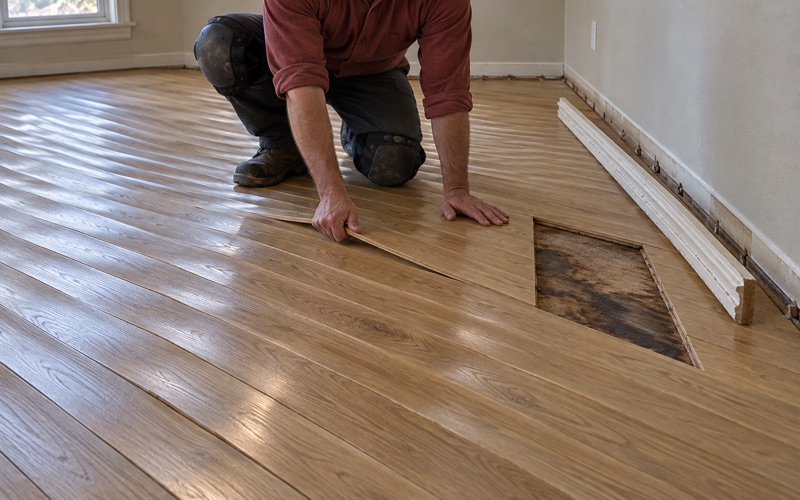
Not every old floor needs replacing. We price the repair-depth ladder honestly: if a screen and recoat will restore the finish, we will tell you so rather than sell a full sand. Where damage is localized, a dutchman patch, a weave-in repair or straight board replacement keeps the original field intact.
Work in a house built before 1978 also falls under the EPA RRP lead-safe rule, which changes containment and cleanup rather than the flooring itself. We plan for that at the estimate so it never becomes a mid-job schedule change.
Las Colinas floors and Irving’s annual risk rating
Irving rents more than it owns: 38.1% of occupied units are owner-occupied, 36,146 owner against 58,699 renter out of 94,845 total. That ratio changes who calls us and what the call is about. A homeowner, a landlord and a management company each need a different scope document.
Single-family homes on a master-planned slab
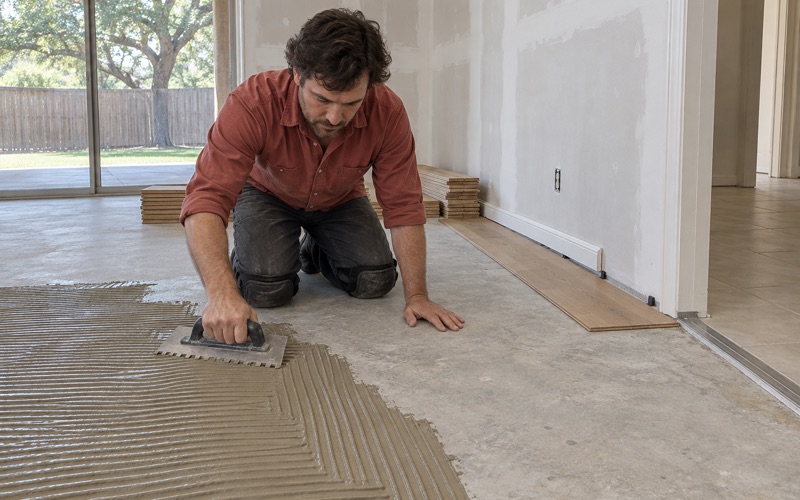
The 3,400 single-family homes inside Las Colinas are largely slab-on-grade, which makes glue-down installation and floating installation the usual candidates for engineered hardwood. Nail-down installation is not, and where a slab may be post-tension nothing is fastened into it until the tendon layout is confirmed against the builder’s record.
We do not assume a foundation type from an address or a subdivision name. What can be verified on site we verify; what cannot, we write into the scope as a condition rather than a promise.
What the annual risk rating means if you manage units
The city inspects each multifamily complex at least once a year and assigns it a risk rating based on the property’s condition, its age and its infrastructure, and properties rated Level 3 are inspected at least twice per year. An owner, manager or lienholder whose property receives a risk rating of 5 on any inspection on or after January 1, 2025 must improve that rating to 4 or better within twelve months of the inspection, failing which the building official revokes the certificate of occupancy.
That clock is why unit flooring here is a scheduling problem as much as a product question. We sequence unit by unit around occupancy, so a building can work through a list without emptying a whole floor of tenants at once.
Documentation an inspector or an adjuster will accept
Water damage jobs come with the documentation a claim needs: dated photographs, moisture readings and an itemized scope. Readings are taken before anything is removed and again before the replacement boards go down, so the file records a condition rather than an assertion. That is as useful to a property manager answering the city as it is to an insurer.
A written scope before work starts also means the price is not discovered halfway through the job. Across a portfolio of units that turns flooring into a repeatable line item instead of a series of one-off negotiations, which is usually what a manager needs before approving the first one.
Choosing an approach for the Irving address you actually have
The decisions people usually open with — species, wear layer, sheen — are the ones we close with. The substrate and the building type narrow the field long before taste enters it, which is why they come last rather than first. What follows is how we work through them once the slab and the subfloor are known quantities.
Species and wear layer thickness
White oak and red oak carry most of what we install here, with hickory where a harder surface is wanted; the Janka hardness rating is a fair comparison between them, though it says nothing about the finish sitting on top. Plank width often matters more than species on a slab, since a wider board moves more with the seasons.
Wear layer thickness is what decides whether an engineered floor can be sanded later and how often. In a rental unit that figure is a budget question; in a house you intend to keep, it is the difference between refinishing once and replacing outright.
Finish, sheen and how long a room is out of use
Waterborne polyurethane cures quickly and stays clear, oil-modified polyurethane ambers over time and wants longer between coats, and hardwax oil is the one that can be spot-repaired without recoating an entire room. Sheen level is best chosen against the light the room actually gets rather than a showroom swatch.
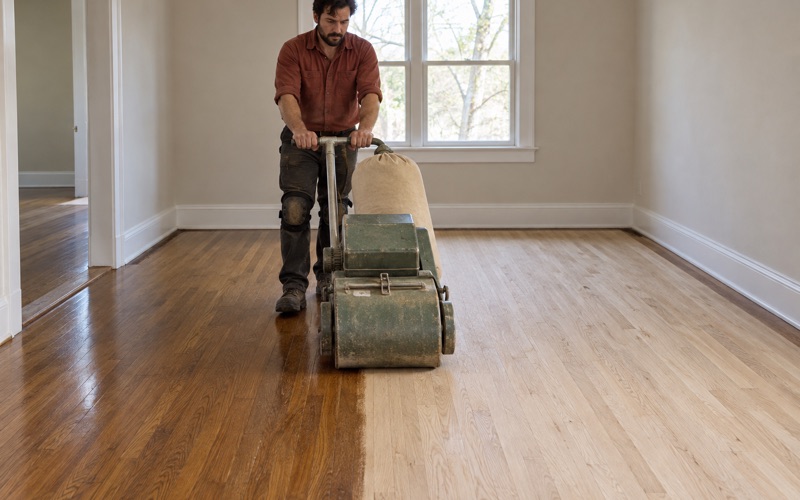
Sanding is done with dustless equipment and containment, and the rest of the house is sealed off from the work area. We run the grit sequence with a drum sander, an edger and a buffer, and one crew stays on the job from the first day to the last — the sanding is never handed to a subcontractor.
Sequencing around a slab that is still moving
Dallas County lies largely within the Blackland Prairie, developed on the Eagle Ford Shale, which contains bentonite whose montmorillonite content produces differential swell and contraction reported at up to seven inches and known to cause foundation and roadway problems. We sequence around foundation work and plumbing repairs instead of laying a floor over a slab that has not settled. Furniture is moved out and put back, and the room is left clean at the end of each day. Twenty years on North Texas slabs is largely what that discipline is made of.
- 20+ Years on Wood Floors
- Dustless Sanding and Containment
- Written Scope Before Work Starts