Flower Mound Wood Flooring installs, sands and repairs wood flooring in Lake Dallas, and we have been doing that work for more than twenty years, the last two decades of it on North Texas housing rather than somewhere else. This is not a single-vintage town, and a flooring quote written as though it were will be wrong somewhere.
Of the 3,294 housing units in the city, 2,188 are single-family detached. The other 1,106 — a third of everything here — are attached, stacked or otherwise multi-unit, and flooring in those carries obligations a standalone house never raises. We specify for the structure actually in front of us.
You get a written scope before work starts, so the price is not discovered halfway through the job. If a screen and recoat will do what you want, we will tell you so rather than sell a full sand, and one crew stays with the job from the first day to the last.
The oldest housing in the city, and what sits under it
Sixty-one units in Lake Dallas, 1.9% of the stock, were built before 1960, and forty of those date to the 1940s. Nearly everything else is newer: 32.6% of the city went up between 2000 and 2009 alone. That small old cohort is the only place where original solid strip flooring is a live possibility rather than a guess.
From French Settlement to Garza to Lake Dallas
The town was settled in 1852 as French Settlement and formally constituted as Garza in 1881, when the Dallas and Wichita Railway built through it. It took the name Lake Dallas after the reservoir was impounded in the late 1920s, and it did not incorporate until 1965, at the end of a nine-year legal struggle among residents.
That sequence explains the housing curve better than any general statement about age would. Population stood at 489 in 1940 and 1,431 in 1970, so the pre-1960 units are the physical remainder of a railroad-era townsite that never grew large before the lake and the highway reshaped everything around it.
Sixty-one homes older than 1960
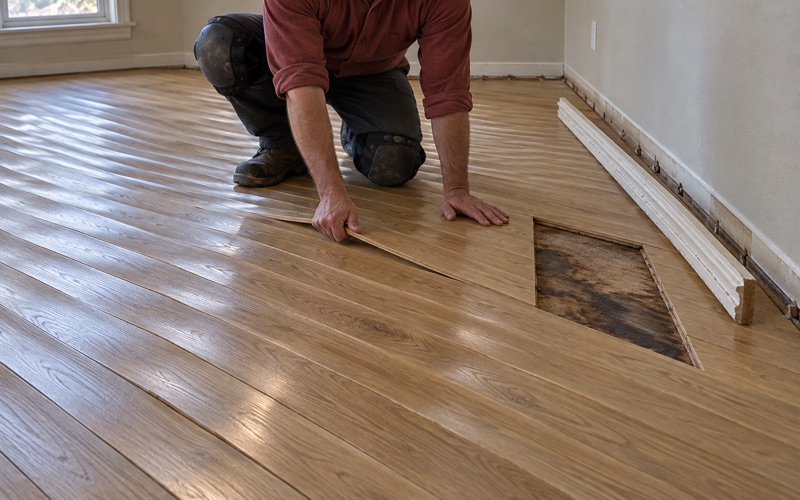
In houses of that age we expect original solid strip flooring, often narrow-plank red oak, sitting under one or more later coverings. It is frequently worth saving. Wear layer thickness decides that question: enough sound wood above the tongue and a full sand is available, too little and board replacement or a dutchman patch is the honest answer.
We measure the remaining thickness at the worst spot in the room rather than the best one, and we tell you what we found before a drum sander comes off the truck. A floor already sanded twice is not a floor to sand a third time on optimism, and lacing in new boards where they are needed beats taking a whole surface too thin.
When the subfloor is not concrete
Most of Lake Dallas sits on slab, and most of our installations here are slab installations. In the oldest cohort that assumption does not hold automatically, and a framed wood subfloor changes the fastening schedule, the flatness work and the moisture question all at once. We look before we specify, not after.
Opening a closet or a floor return usually settles it in ten minutes. Over framing we check joist spacing, which in construction of that era is often not the sixteen inches modern products are engineered around, and we set flooring cleats or staples and fastener crown width to what the structure actually gives us.
Looking for hardwood floor refinishing closer to Lewisville? See Lewisville Hardwood Floor Refinishing.
A third of Lake Dallas is not a single-family house
The 1,106 units here that are not detached houses are a standing part of our work, not an exception to it. Attached and multi-unit flooring differs from the same square footage in a standalone home, and the differences are contractual as much as technical. We plan for both before any boards are ordered.
Sound transmission through a shared assembly
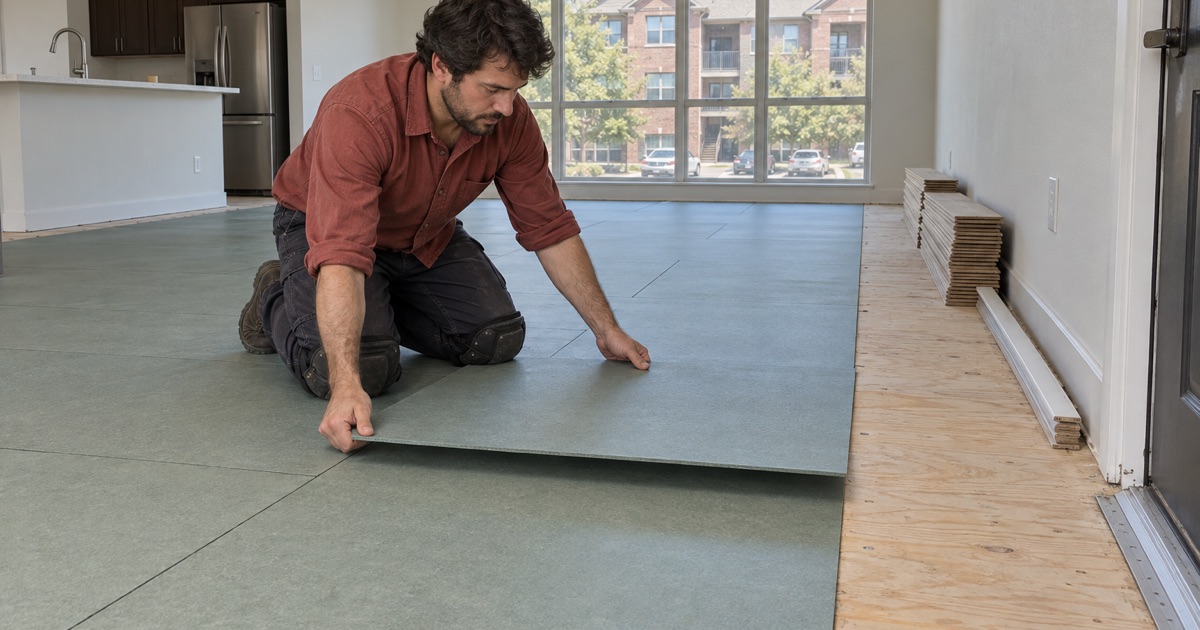
A hard surface over a shared floor or wall assembly transmits impact noise to the unit below or beside it. That is the most common reason a finished wood floor draws an objection after the fact, and it is preventable at the specification stage with the right acoustic underlayment beneath a floating installation.
Where a floating installation is not appropriate, glue-down over an acoustic membrane does the same job differently. Either way the buildup gets decided before demolition begins, because finished floor height at every door threshold follows from it, and so does the reducer, stair nosing or T-molding at each transition.
Association rules on hard-surface flooring
Buildings with shared walls or shared floors frequently carry their own rules on hard surfaces: permitted assemblies, required underlayment, sometimes a limit on which rooms may have wood at all. We ask for that document before quoting rather than after, because a compliant floor specified late costs more than one specified first.
The assembly then goes into the written scope, so what you approve is what the association reviews. If a rule rules out the product you had in mind, you hear it from us in the first conversation instead of in a letter once the floor is already down.
Engineered and solid in an attached unit
Engineered hardwood wins most attached-unit jobs on merit. It is dimensionally stable, it accepts both glue-down installation and floating installation, and it tolerates a slab better than solid hardwood does. Wear layer thickness is the number worth comparing between products, not the price per square foot, because a thin wear layer can never be refinished.
Where solid hardwood is workable we will say so plainly. White oak, red oak and hickory each behave differently underfoot and under a sander, and the Janka hardness rating is a useful shorthand for how a floor will look after a few years of ordinary traffic in a busy household.
Rental turnover flooring
Of 3,112 occupied units in the city, 958 are renter-occupied. Turnover flooring specified by a landlord or a property manager is therefore a standing category of work in Lake Dallas rather than an occasional job, and it comes with priorities of its own that we quote against directly.
What a turnover specification actually asks for
Durability and price lead the decision; finish character comes third. The floor has to survive a move-in and a move-out, clean up between tenants without a full refinish, and be repairable in one room without redoing the whole unit. We specify against that, not against a showroom display.
In practice that usually means engineered hardwood with a wear layer thick enough for one future sand, a mid sheen level that hides scuffing better than gloss does, and a waterborne polyurethane that lets the unit be walked on sooner than an oil-modified polyurethane would allow.
Getting a unit back on the market
Vacancy is the real cost, so we sequence a turnover to put the noisy, dusty work in one block and to fix the cure schedule before starting. What you get from us is the date the unit can be occupied, which is the number that matters, rather than the date our trucks leave.
Dustless sanding with containment counts for more here than almost anywhere else, because a neighboring occupied unit does not move out to suit your schedule. We seal the rest of the building off from the work area and leave the unit clean at the end of every working day.
Repair before replacement
Most turnover floors do not need replacing. A screen and recoat with a buffer brings a tired surface back in a day, and a weave-in repair or straightforward board replacement handles the damaged patch by the dishwasher without running a visible seam across the middle of the room.
We price the repair-depth ladder honestly and in order: recoat, spot repair, partial sand, full sand. Across a portfolio of units that order is worth real money over a few years, and we would rather be the contractor you call again than the one who sold you a floor too early.
Wood flooring services in Lake Dallas
We install, sand, refinish and repair wood floors throughout the city, in owner-occupied houses, attached units and rentals alike. What varies is the sequence and the specification, and both get settled in writing before anyone starts moving furniture out of a room.
Moisture testing before an installation date
We test the slab for moisture before an installation date is set, not after the boards are on site. That means an ASTM F2170 in-situ relative humidity test, or a calcium chloride test where the slab suits one, together with pinless moisture meter readings taken across the wood itself.
The lake is part of this. Lewisville Lake absorbed the older and smaller Lake Dallas reservoir on October 28, 1957, when the old Garza Dam was breached, and lots near the water sit on ground with a shallow water table and a lake-facing grade. Denton County soils mapping shows fine sandy loam and loamy fine sand through this area.
Where the readings call for it we specify a vapor retarder beneath the finished floor, and boards acclimate inside your house before a single one is fastened down. We also sequence around foundation work and plumbing repairs instead of laying a floor over a slab that is still moving under it.
Sanding, refinishing and finish choice
Refinishing runs a full grit sequence: a drum sander in the field, an edger at the perimeter, a buffer to blend the two. Finish follows the room’s use, whether that is waterborne polyurethane for a fast return to service, oil-modified polyurethane for warmth, or hardwax oil where a repairable matte surface is wanted.
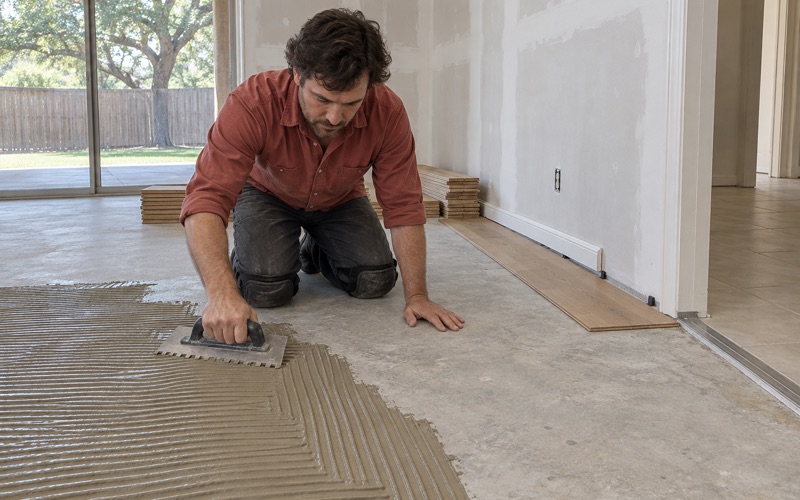
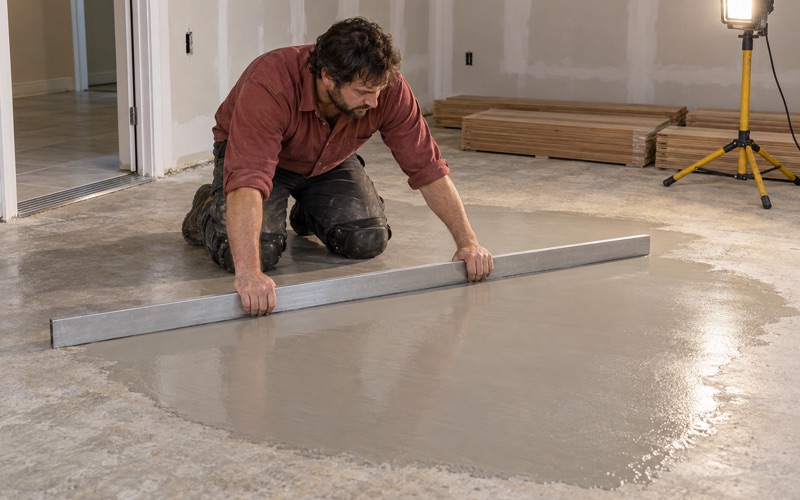
Where the subfloor needs work first, we handle it — concrete grinding for the high spots, self-leveling underlayment for the low ones — because subfloor flatness tolerance separates a quiet floor from one that ticks underfoot. Expansion gap at every wall, and quarter round, stair tread and riser details finished to match.
Permits, code editions and inspection
Lake Dallas adopted the 2018 International codes effective May 23, 2019 — the IBC, IRC, IECC, IFC, IFGC, IMC and IPC — alongside the 2017 National Electrical Code, with amendments from NCTCOG and the Lake Cities Fire Department. We work to the edition your city has actually adopted rather than a generic national one.
Building permits are required for construction work inside the city limits, and every permit requires a final inspection. The city employs no in-house inspector: Bureau Veritas schedules and performs inspections under contract to the City of Lake Dallas and returns reports for documentation, and plan review, where it is required, can take up to ten business days.
We build that calendar into the schedule rather than discovering it midway. Where a floor forms part of a water damage claim, the job comes with the documentation a claim needs — dated photographs, moisture readings and an itemized scope — and furniture is moved out and put back as part of the work.
- 20+ Years on Wood Floors
- Dustless Sanding and Containment
- Written Scope Before Work Starts