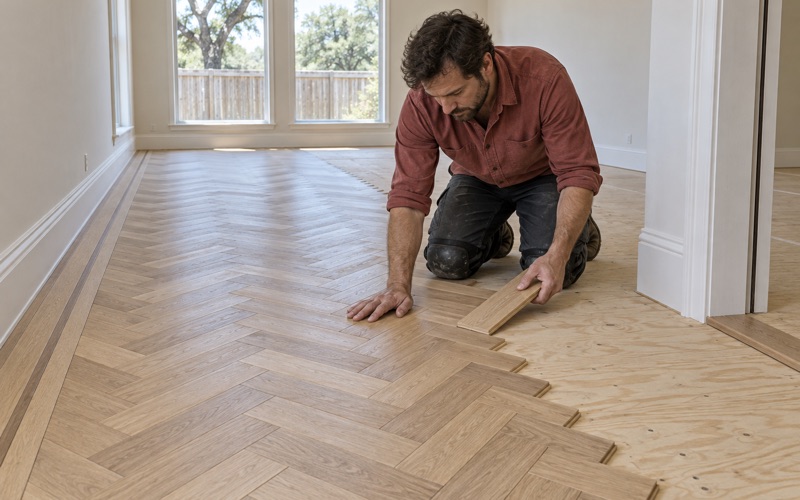
Flower Mound Wood Flooring has spent more than twenty years installing, sanding and repairing wood flooring on North Texas slabs, and wood flooring in Lantana has become a steady share of that work. The houses in this community went up close together in time, which means the floors inside them are reaching the end of their finish close together in time too.
What separates a Lantana job from the rest of our work starts before the first board comes up, and it has nothing to do with the floor. It has to do with who sets the standard, who signs off, and what record exists afterward. In most of the towns we work in, a building department answers all three; here, nobody does.
We put a written scope in your hands before anything begins, so the price and the standard are both settled at the front of the job instead of discovered halfway through it. On a Lantana house that document does more work than usual, because it is the only place those terms get written down.
Who signs off on work inside a Lantana home
Every job here starts with a question about authority: who has to agree, and to what standard. In an incorporated town the answer is a building department with a counter and a plan reviewer. In Lantana the answer is a county, two elected water districts and a community association, and that difference shapes the whole job.
A community without a municipal building department
Lantana is a census-designated place in unincorporated Denton County, not an incorporated town, so it has no local government and no building department of its own. Residential construction standards here do not come from a local ordinance at all — they come from the county, and the county’s reach into an existing house is far narrower than a municipality’s would be.
For a homeowner that sounds like freedom, and in part it is. It also means there is no plan review to lean on and nobody to blame if a contractor cuts a corner, so the standard a crew holds itself to is the only standard on the job. We treat that as a reason to write more down before we start, not less.
Denton County Fresh Water Supply Districts No. 6 and No. 7
The community sits inside Denton County Fresh Water Supply District No. 6 and Fresh Water Supply District No. 7, along with Denton County Development District No. 4. The two water districts are the taxing authorities here, and they are governed by publicly elected officials who function much the way a council does elsewhere.
For flooring that matters less on the technical side than on the practical one. Your utilities, your assessments and a good share of the community’s governance run through boards you vote for rather than through a municipality, and on a water-damage job those are the people whose service records are in play.
The Lantana Community Association
The Lantana Community Association is the HOA, and with no municipal code-enforcement layer sitting above it, association rules carry more practical weight here than they would next door in an incorporated town. The association also holds a ten-year sidewalk-repair agreement with the water district boards, which is a fair measure of how much ordinary upkeep runs through it.
Interior flooring rarely triggers association review, but access, deliveries, dumpster placement and work hours can. We ask about the current rules before we put a date on the calendar, because a crew turned away at the gate on day one costs you a day and costs us one too.
Looking for wood-flooring closer to Highland Village? See Wood-Flooring Services in Highland Village.
Where the county’s rules reach, and where they stop
The county does have residential construction standards, and they are more specific than most homeowners here expect. What surprises people is how narrow their reach into an existing, occupied house turns out to be once you read them.
The January 26, 2010 Commissioners Court resolution
Denton County Commissioners Court adopted a resolution on January 26, 2010 under Texas Local Government Code chapter 233, subchapter F, applying residential construction standards to work begun after February 1, 2010 in the unincorporated county. New single-family houses and duplexes must conform to the International Residential Code published as of May 1, 2008, or to the IRC edition applicable in the City of Denton, the county seat.
That is a real answer to a question most contractors around here wave off. We work to the code edition your area has actually adopted rather than a generic national one, and in Lantana that means knowing which of those two editions the resolution points at for the scope sitting in front of us.
The greater-than-fifty-percent remodel trigger
The resolution reaches remodeling only when an addition increases the square footage or the value of the existing home by more than fifty percent. An interior remodel below that threshold falls outside it entirely, and pulling up a floor and laying a new one comes nowhere near it in a house this size.
We say that plainly because the alternative is a contractor implying an approval process that does not apply and then billing for the paperwork. Separately, development activity in unincorporated Denton County requires a Development Permit from Denton County Development Services, and where a particular scope sits against that requirement is something we confirm rather than assume.
Three inspections, and the builder hires them
On covered work the county requires a minimum of three inspections: the foundation before concrete is placed, framing and mechanical before drywall or other interior wall covering goes on, and a final at completion. The builder hires the inspector; the county does not send one.
The resolution accepts a licensed engineer, a registered architect, a TREC-licensed professional inspector, a municipality’s licensed plumbing inspector, a building inspector employed by a political subdivision, or an ICC-certified residential combination inspector. That documentation goes to the home buyer and to Denton County Public Works on county forms.
The consequence lands years later, at resale. There is no municipal permit file to pull on a Lantana house, so whatever record exists is the record someone kept at the time. It is one reason our water-damage work ships with dated photographs, moisture readings and an itemized scope.
Twenty years of builder flooring, installed all at once
Governance explains who signs off. The construction dates explain why we are in this community as often as we are: it was built almost entirely inside a single decade, and floors laid within a few years of each other wear through within a few years of each other.
A housing stock built inside one decade
Lantana holds 3,942 housing units. Of those, 2,338 — 59.3 percent — were built between 2000 and 2009, and 97.0 percent of the community dates from 2000 or later (ACS 2024 five-year estimates, table B25034). Single-family detached homes account for 3,877 units, 98.3 percent of the stock, and 93.8 percent are owner-occupied.
A stock that concentrated does something unusual to flooring demand. The dominant job is not a scattering of unrelated problems but the first full replacement or refinish of original 2000s builder-grade product, across houses of near-identical age and specification, all arriving in the same handful of years.
What the original product looks like at twenty years
Builder packages from that decade leaned on red oak and, toward the end of it, prefinished engineered hardwood with a thin wear layer. Two decades in, the finish is usually gone at the entries and down the traffic lanes while the boards underneath are still perfectly sound.
That distinction is worth real money to you. A worn finish over intact wood is a refinishing job; a worn-through wear layer on engineered product may not have enough material left above the core to sand at all. We measure the remaining thickness rather than guess at it, and we tell you which one you own before you commit to a scope.
The repair-depth ladder, priced honestly
If a screen and recoat will do the job — abrade the existing finish, lay a fresh coat over the top of it — we will tell you so rather than sell a full sand you do not need. It costs a fraction of the deeper job and puts you back in the room far sooner.
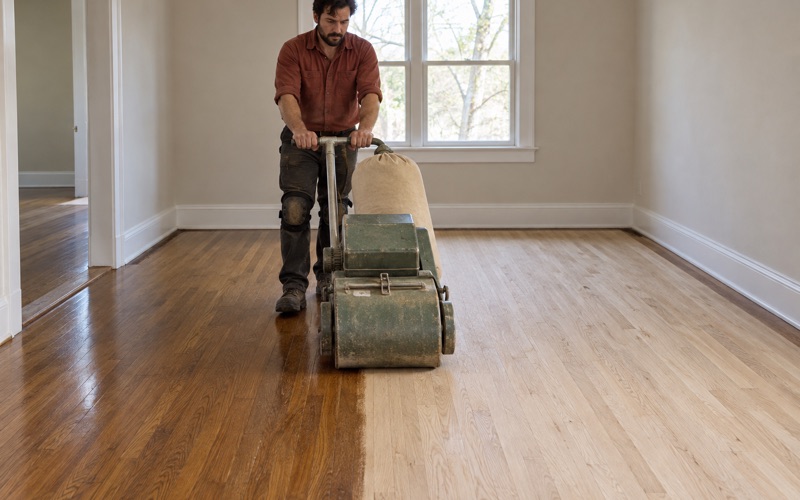
When a floor is genuinely past that point, a full sand runs a proper grit sequence with a drum sander, an edger and a buffer before any finish goes down. Dustless sanding with containment keeps the rest of the house out of the work, and one crew stays on the job from the first day to the last.
Wood flooring services in Lantana
Most Lantana houses need the same three things, in roughly the same order: the original floor brought back, a slab handled properly when a floor is replaced outright, and the occasional repair after water finds its way under the boards.
Sanding, refinishing and finish selection
Refinishing is the bulk of what we do in this community, for the reason the construction dates make obvious. Finish choice is the decision homeowners most often underrate: waterborne polyurethane cures fast and stays clear, oil-modified polyurethane ambers over time and adds warmth, and hardwax oil is the easiest of the three to spot-repair later.
Sheen level does as much work as the product itself. A lower sheen hides the fine scratching that a house with children and dogs will put back into a floor inside a year, which is why we walk samples through your own rooms and your own light before anything is ordered.
New installation over a Lantana slab
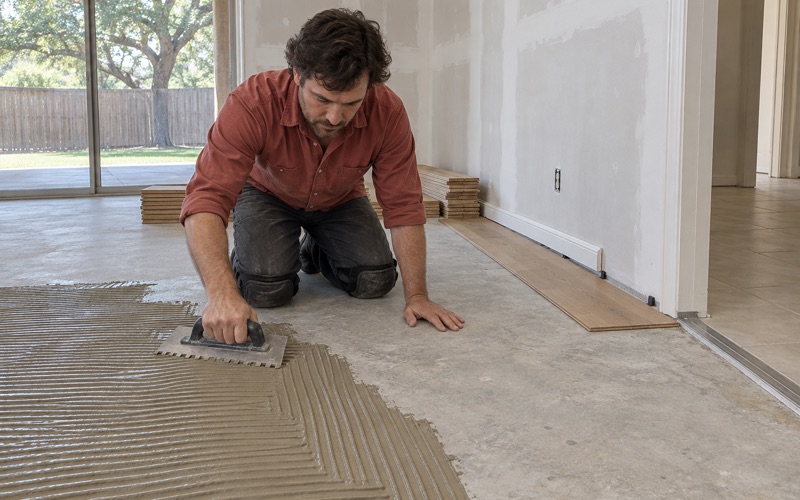
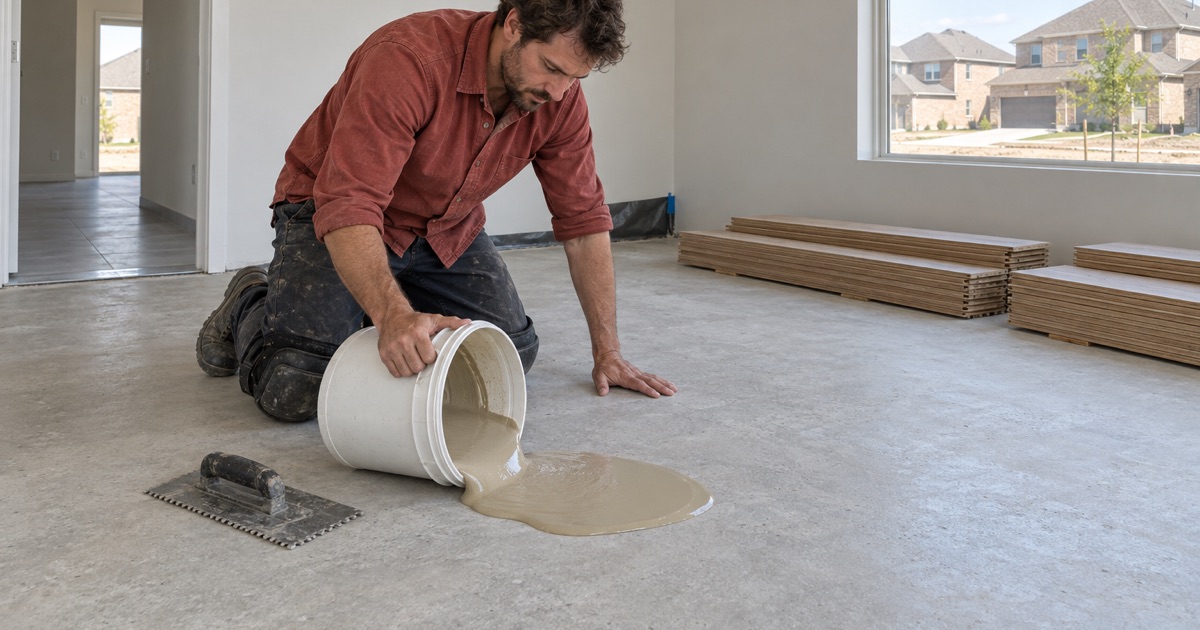
We test the slab for moisture before an installation date is set, not after the boards are on site: an ASTM F2170 in-situ relative humidity test or a calcium chloride test, backed by pinless moisture meter readings taken across the room. Boards then acclimate inside your house before a single one is fastened down.
Lantana sits in the Eastern Cross Timbers, a band of slightly acidic sandy and sandy-loam soils on Cretaceous Woodbine and Trinity strata rather than the deep black prairie clay much of the metroplex is built on. That changes the slab conversation without ending it, and we still sequence around foundation work and plumbing repairs instead of laying a floor over a slab that is still moving.
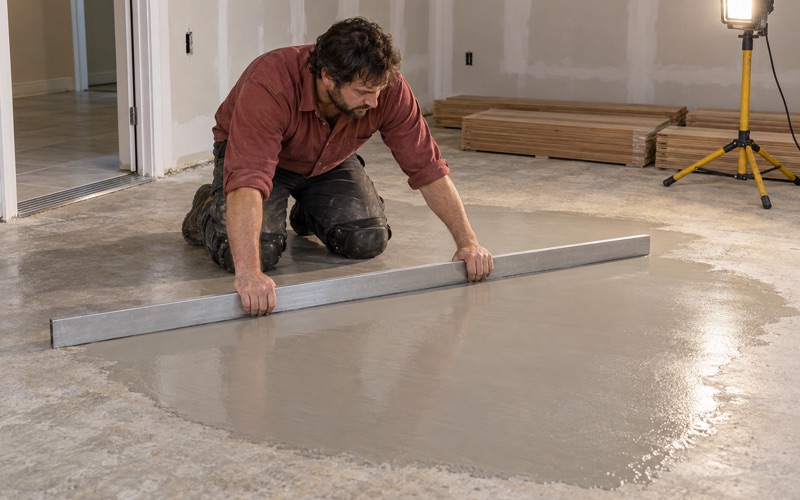
Method follows the substrate and the product. Glue-down or floating installation over concrete, nail-down over a plywood subfloor with the right flooring cleats or staples, a vapor retarder where the assembly calls for one, and expansion gaps held honestly at every wall. Subfloor flatness tolerance gets corrected with concrete grinding or self-leveling underlayment before anything is laid.
Board replacement, weave-in repairs and water damage
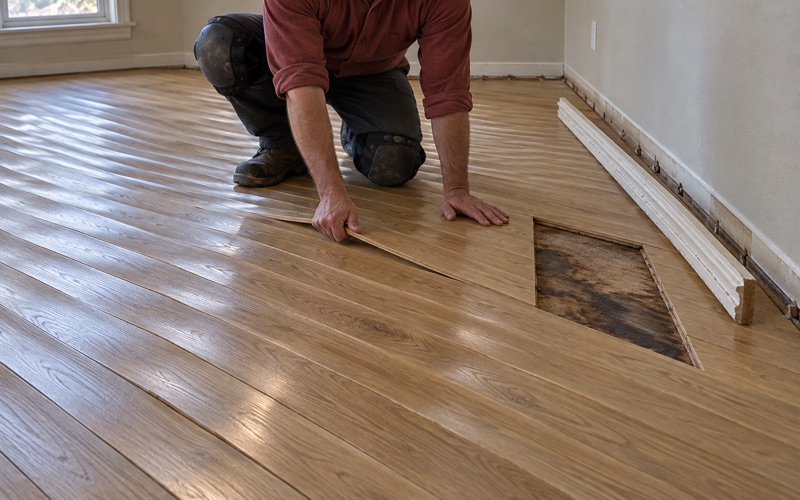
A dishwasher line or a slab leak takes out a few square feet, not a house. A weave-in repair laces new boards into the existing field so the patch disappears into the run; a dutchman patch handles a smaller defect without disturbing the boards around it. Species and plank width have to match, which is easier on a 2000s red oak floor than on most.
Water damage work comes with the documentation a claim needs: dated photographs, moisture readings and an itemized scope. Furniture goes out and comes back, transitions such as T-molding, reducers, stair nosing and quarter round are replaced rather than forced back into place, and the room is left clean at the end of every day.
- 20+ Years on Wood Floors
- Dustless Sanding and Containment
- Written Scope Before Work Starts