Flower Mound Wood Flooring has handled hardwood floor refinishing in Lewisville for more than twenty years, and the last two decades of that work have been spent on North Texas slabs rather than on somewhere else’s subfloors. It shapes how we quote. A floor here is a wood assembly sitting on concrete that moves with the season, so we read what is under the boards before we say anything about the boards.
Most of the refinishing calls we take in this city arrive as one question with two answers: sand what is already down, or tear it out and start over. That decision is rarely about taste. It comes down to how much wear layer is left, how many days the house or unit can sit empty, and what the slab beneath it has been doing.
We answer it in writing before a machine comes through the door. You get an itemized scope, a repair-depth ladder priced honestly, and one crew from the first day to the last — the sanding is never handed off to a subcontractor partway through.
The 1990s cohort at the sand-or-replace fork
The single largest slice of housing here went up in one decade: 12,891 of Lewisville’s units were built in the 1990s, more than in any other ten-year span. Those floors have now reached the age where the original builder-grade finish is walked through in the traffic lanes while the wood underneath is often perfectly sound.
Solid or engineered decides everything after it
The first thing we establish on a 1990s floor is what kind of floor it is. A solid three-quarter-inch red oak or white oak floor can take a full sanding several times over its life. A 1990s engineered floor with a thin veneer may take one careful pass, or none at all, and a drum sander will go straight through it.
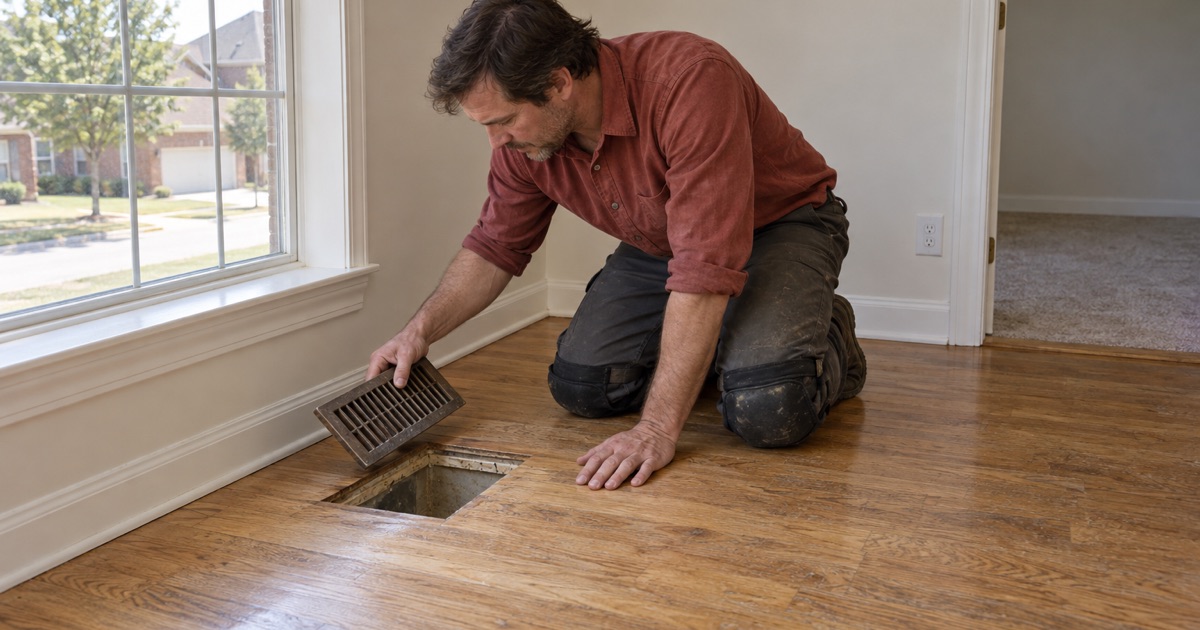
We do not guess at that from the surface. Lifting a floor register, pulling a threshold or taking off a length of quarter round shows us the board edge, and the board edge tells us the construction, the plank width and the species we are actually working with.
Measuring what is left of the wear layer
On a solid floor the usable material is the distance from the surface down to the top of the tongue, and every full sanding spends a measurable share of it. On an engineered floor it is the veneer above the core. We measure that at an exposed edge rather than estimating it from how tired the finish looks.
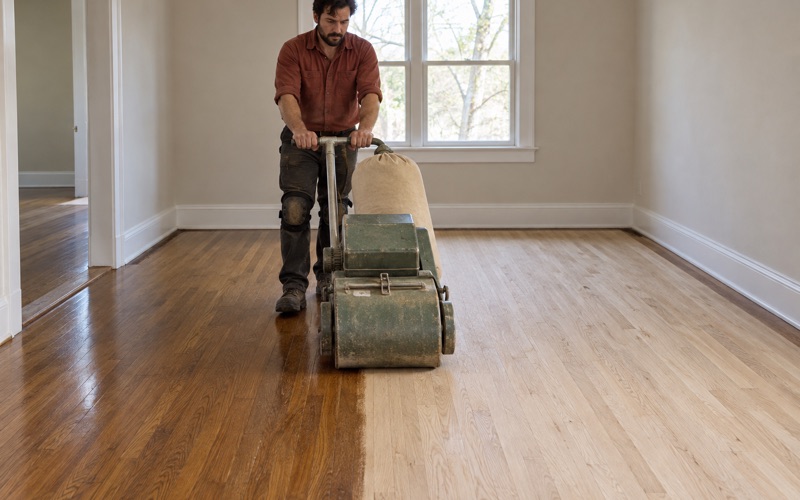
The measurement is what makes the recommendation honest. A grit sequence run with a drum sander and an edger removes a predictable amount of wood, and if what is left cannot absorb that and still leave you a floor that can be refinished again in ten years, we will say replacement is the better spend.
When a screen and recoat is the honest answer
Plenty of these floors do not need a full sand at all. Where the finish is worn but the wood beneath it is not stained, grayed or cupped, a buffer and an abrasive screen followed by a fresh coat of waterborne polyurethane restores the surface for a fraction of the cost and a fraction of the downtime.
We price that rung of the ladder before we price the one above it. Selling a full sand to a floor that only needed a recoat spends wood that cannot be put back, and it is the quickest way to shorten what is left of a floor’s life.
Looking for wood-flooring closer to Coppell? See Wood-Flooring in Coppell.
Refinishing on a landlord’s calendar
Renter households outnumber owner households in Lewisville, 27,874 to 24,041, so turnover work is not an occasional job here — it is a routine one. The question changes shape when the property is leased. The constraint becomes a vacancy window on a calendar rather than a homeowner deciding they are finally ready.
Working inside a vacancy window
Give us the move-out date and the move-in date and we will tell you what genuinely fits between them. Dustless sanding with containment keeps the rest of the building out of the work, and sealing the work area off matters more, not less, when a unit shares walls and a stairwell with neighbors who never moved out.
Finish choice is partly a scheduling decision. Waterborne polyurethane returns a room to service sooner and stays clear over white oak; oil-modified polyurethane ambers as it ages and asks for more days; hardwax oil gives you a repairable surface, which suits a floor someone intends to keep touching up between tenants.
Pricing the repair-depth ladder
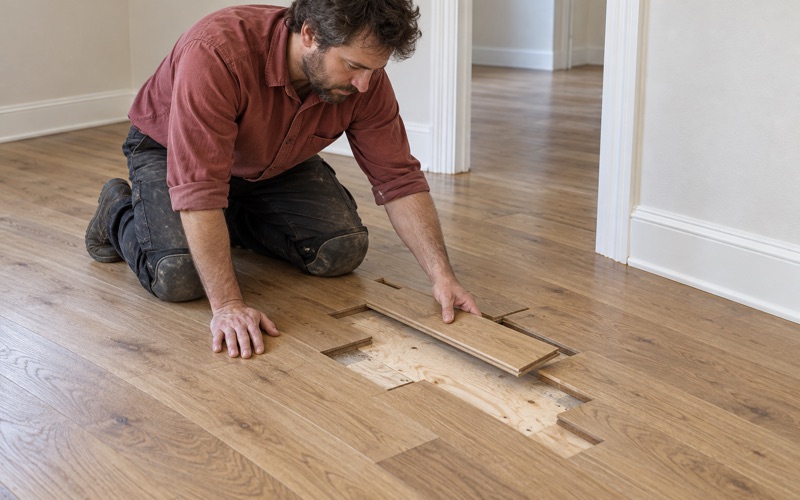
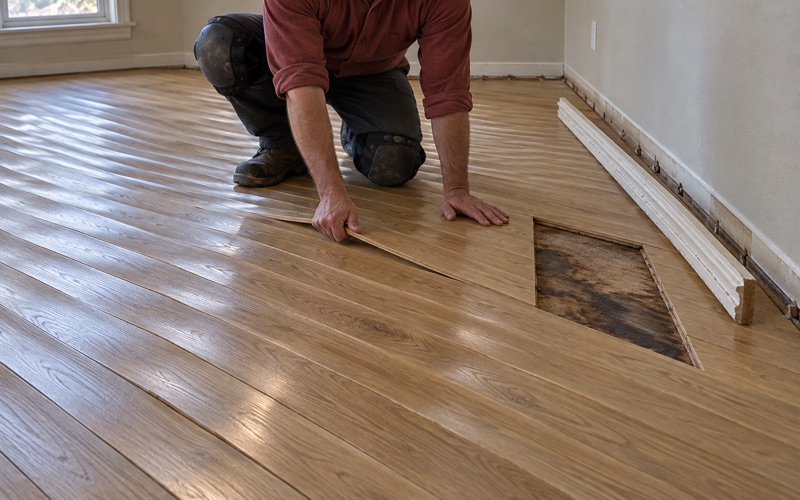
Between tenancies the right answer is often narrow and specific. A weave-in repair where a dishwasher leaked, a dutchman patch at an abandoned register cut, board replacement in the one doorway that took the worst of the traffic — work like that carries a floor through several lease cycles before it needs the full treatment.
A written scope before work starts is what keeps that from drifting. Nobody should discover the price of a job halfway through it, and a rental turnaround has no slack in it for a surprise.
The code edition in force, and who signs off
Lewisville has adopted the 2021 International Residential Code, along with the 2021 IBC, IFC, IPC, IECC and IMC and the 2020 National Electrical Code. Plan review, permitting and inspection of private construction are handled by City of Lewisville Building Services. We work to the edition your city has actually adopted rather than a generic national one.
That matters wherever flooring touches something inspected. A subfloor build-up changes stair riser heights and door clearances, and a transition at the top of a flight changes the stair nosing. Under half of the city’s housing units are single-family detached, so a good share of this work happens in condos, townhomes and attached units, where an association’s own rules on what may sit under a hard surface upstairs can set the build-up height before anyone has chosen a species.
Old Town’s older slabs and what the ground does
Old Town Lewisville is the original commercial core: two rows of roughly hundred-year-old buildings along Main Street, where the earliest structures date to the 1860s and the first brick went up just before 1900, with an adjacent historic home district the city promotes. Housing in and around it sits at the older end of the stock, and that changes the work.
Older slabs change what we can fasten into
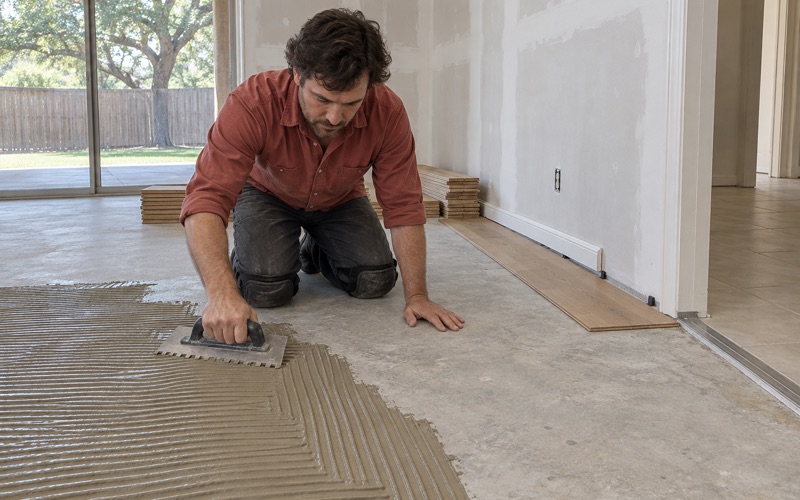
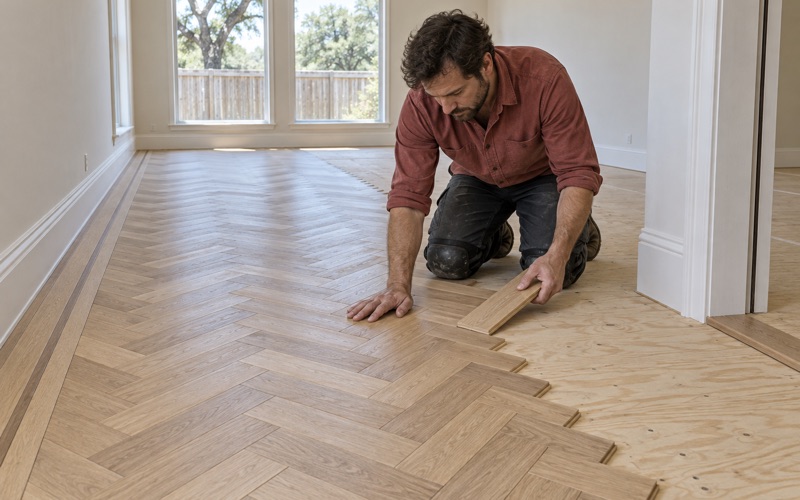
A house built between the 1950s and the 1970s is more likely to sit on a conventionally reinforced slab than on a post-tension slab. That governs what we can fasten into for a sleeper system or a plywood subfloor, and whether nail-down installation with cleats or staples is available at all or the job becomes a glue-down or a floating floor.
Where a post-tension slab is in play we do not drill blind into it. Confirming what the slab is before anyone picks up a fastener is a short conversation that heads off a very expensive afternoon.
Testing the slab before a date is set
We test slabs for moisture before an installation date goes on the calendar, not after the boards are sitting in the garage. In-situ relative humidity probes to ASTM F2170 read what the concrete is actually holding, and a calcium chloride test and a pinless moisture meter on the wood fill in the rest of the picture.
On an older slab there may be no vapor retarder beneath the concrete at all, which changes both the reading and the remedy. A number we do not like is a reason to change the assembly or the schedule, and it is far cheaper to learn it in week one than in month three.
Blackland Prairie clay and seasonal movement
Blackland Prairie clay swells and shrinks with the season, and the slab above it domes and dishes along with it. A post-tension slab is a stronger slab, not a stationary one. Floors telegraph that movement as seasonal gapping, cupping over a dished area and squeaks at the transitions, so flattening the substrate is part of the repair rather than an extra.
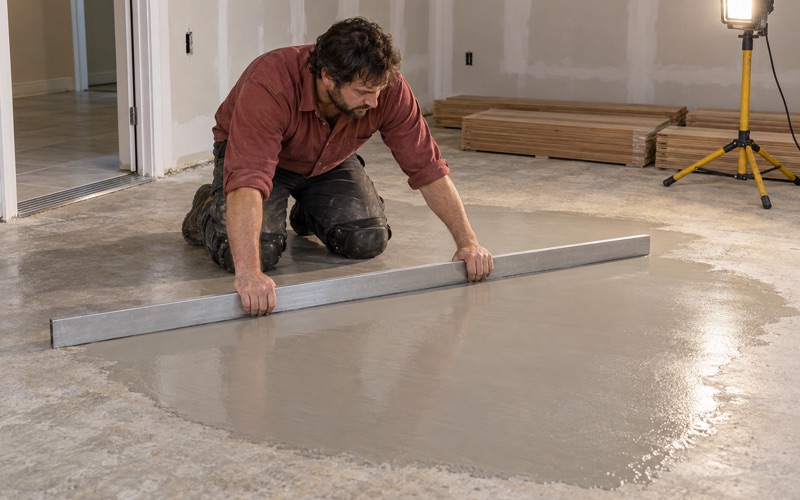
Where the subfloor flatness tolerance is not met we grind the high spots or pour self-leveling underlayment instead of laying boards over a wave. We sequence around foundation work and plumbing repairs rather than finishing a floor on a slab that is still moving, and we leave a proper expansion gap at every wall and every vertical obstruction.
Lewisville sits in National Weather Service public forecast zone TXZ103, the Denton County zone, and the indoor swing between a humid spring and a dry winter is what drives acclimation here. Boards sit inside your house, in the rooms they will live in, before a single one is fastened down.
Lewisville Lake, the flood pool and water damage
The Corps of Engineers began Lewisville Dam in 1948, and the lake was created when the dam was completed in 1955. The U.S. Army Corps of Engineers Fort Worth District manages the reservoir, and both the lake and its flood pool sit inside the city.
What a flood pool changes about a floor
Shoreline and floodplain property carries a water-damage job type that has nothing to do with the weather on the day of the call. Insurance and restoration expectations there are different from an inland subdivision, and so is the paperwork, so we plan around that from the first visit rather than discovering it at the end of the job.
Reading a wet floor before sanding it
A soaked floor cups first, as the boards take on moisture from below and swell at their edges. Sanding a cupped floor flat before the assembly has dried leaves you with crowned boards a month later, when the middles rise and the edges settle back down. Buckling and tenting sit further along the same road.
So we meter the wood and the slab and wait for a stable reading before a machine touches anything. Sometimes the honest answer is that a section is past saving and needs board replacement laced into the surrounding floor, with the sanding and finishing carried across the whole run so the repair disappears into it.
The documentation a claim needs
Water damage work leaves our hands with dated photographs, the moisture readings we took and an itemized scope, because that is what a claim gets decided on. We would rather hand an adjuster a record made at the time than reconstruct one from memory six weeks afterward.
The rest is ordinary courtesy. We move the furniture out and put it back, seal the work area off from the rest of the house, and leave the room clean at the end of every day, which counts for something on a job that runs while a family is still living upstairs.
- 20+ Years on Wood Floors
- Dustless Sanding and Containment
- Written Scope Before Work Starts