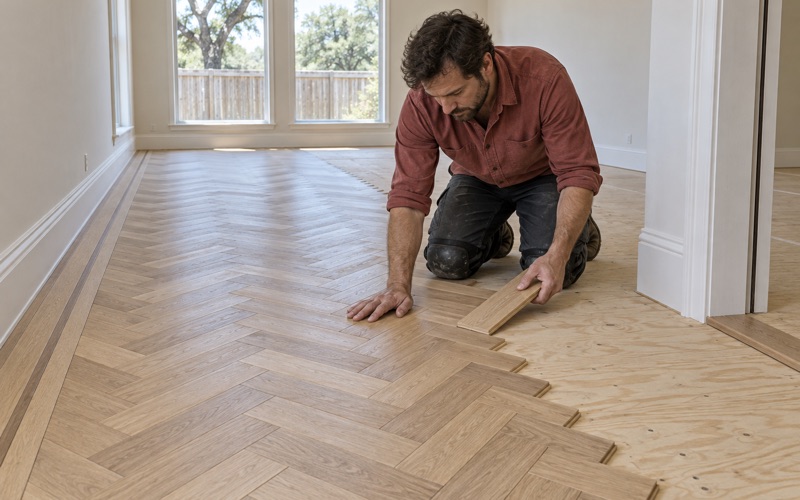
Flower Mound Wood Flooring has been installing, sanding and finishing wood flooring in Oak Point for more than twenty years, and the work here runs to one profile: newer boards, with a newer slab underneath them more often than not. The last two decades of that have been spent on North Texas slabs rather than on somebody else’s subfloors, and where there is a slab, it is what decides whether a floor holds.
We price the repair-depth ladder honestly. If a screen and recoat will restore the finish, we will tell you so instead of selling a full sand, and you get a written scope before anyone starts so the price is not discovered halfway through the work. One crew stays on the job from the first day to the last, and the sanding is never handed to a subcontractor.
The rest of how we work is settled before a board arrives. We test the slab for moisture before an installation date is set rather than after the material is sitting in your garage, we let boards acclimate inside the conditioned house before a single one is fastened down, and we sand with containment while the rest of the house stays sealed off from the work area.
Oak Point’s housing is newer than the map suggests
A country address suggests old houses, and here it does not mean that at all. The city was incorporated as a general law municipality in 1976, which puts a hard floor under how far back the housing stock can reach.
Nothing here predates 1960
Of the 2,275 housing units in the city, none was built before 1960, and only 131 of them — 5.8% of the stock — went up before 1990. That one fact takes an entire category of work off the table before we start.
Genuine century-old solid flooring, face-nailed and sanded thin by other people, does not exist in Oak Point. When someone asks us about restoring an antique floor here, the honest answer is that the oldest common flooring in town is around twenty-five years old, and the work is replacement or refinishing of a 2000s product rather than restoration.
346 homes built in 2020 or later
346 units, 15.2% of the entire housing stock, were built in 2020 or later, and 78.7% of the city was built in 2000 or after. Together those numbers describe a town where flooring work is upgrade and warranty-period repair rather than rescue.
It also means most of the floors we replace still look acceptable from the doorway. Wear layer thickness on an original engineered plank is what decides whether refinishing is even an option, and on an entry-level builder product it frequently is not.
A fair share of the work here is post-closing rather than mid-life. Buyers who take a new house with builder carpet in the bedrooms often want hardwood laced into the rest of the plan within a year or two, and the product they choose should meet the TSCA Title VI formaldehyde standard for anything going into a tightly sealed, newly built house.
Detached houses, owned by the people living in them
2,223 of the 2,275 units, or 97.7%, are single-family detached, and all 1,925 owner-occupied units are detached houses. Owners hold 89.5% of the occupied units in the city.
That ownership pattern changes the conversation we have at the estimate. Owners choose a floor around how long they intend to stay, which is why we spend time on species, plank width and Janka hardness rating before we get to price rather than after.
Looking for wood-flooring closer to Justin? See Wood-Flooring Services in Justin.
Upgrading builder-grade flooring
The dominant job here is improving or replacing a floor the builder chose. The first question is always how deep the work actually needs to go.
When a screen and recoat is enough
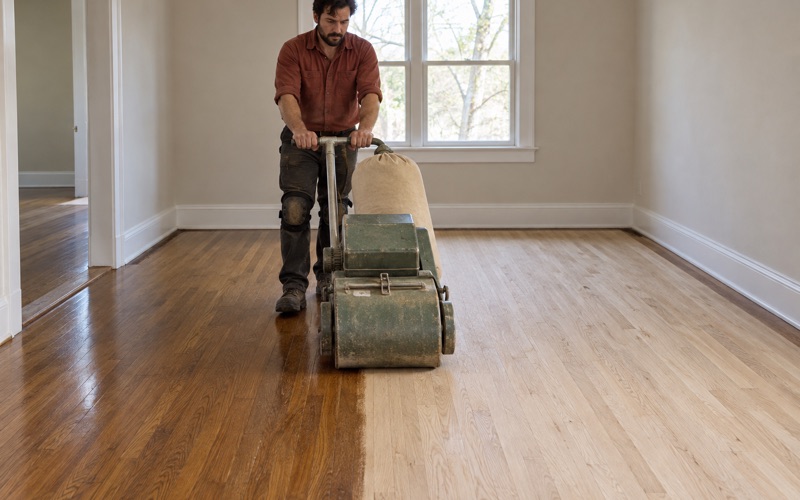
If the wear sits in the finish and not in the wood, a screen and recoat is the right answer: a buffer abrades the existing coating, we vacuum the room down, and a fresh coat of waterborne polyurethane goes on. It costs a fraction of a full sand and it is finished in a day or two.
The limits are real, and we will show you where they are. Scratches through to bare wood, pet stains, cupping, and any plan to change the color of the floor all put the job back onto the drum sander, the edger and a full grit sequence.
Replacing an original 2000s engineered floor
Engineered and laminate product from the 2000s is now reaching the end of its service life, and that is the most common replacement we quote in this city. The wear layer on those planks is usually too thin to sand, so replacement rather than refinishing is the honest recommendation.
What goes back down is worth choosing slowly. White oak takes waterborne polyurethane or a hardwax oil evenly and reads calmer than red oak’s stronger grain, hickory carries a higher Janka hardness rating for households that are hard on floors, and sheen level hides daily traffic better than any species does.
Stairs come into the same conversation more often than people expect, because a builder’s carpeted flight beside a new hardwood floor stops looking finished. Matching stair treads, risers and a proper stair nosing to the field floor is its own scope of work, and we quote it as one instead of folding it into a square-foot number.
Warranty-period repair in a nearly new house
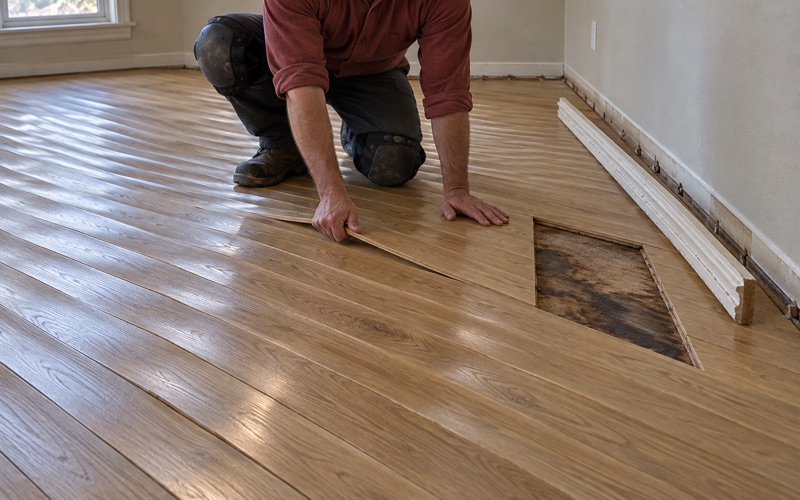
In a house built since 2020 the damage is usually local: a supply line under one run, a delivery gouge, a few boards lifted by another trade. A weave-in repair or a dutchman patch keeps the rest of the floor where it is.
Board replacement and lacing into an existing floor depend on sourcing the same product, or close enough that the transition disappears under finish. Where it cannot be matched, we say so before we start rather than after the floor is open.
When the damage came from water, the paperwork matters nearly as much as the repair. We document those jobs the way a claim needs them documented — dated photographs, moisture readings taken before and after drying, and an itemized scope — so an adjuster is reading measurements instead of an estimate written from memory.
Homes built since 2020 and a slab still giving up water
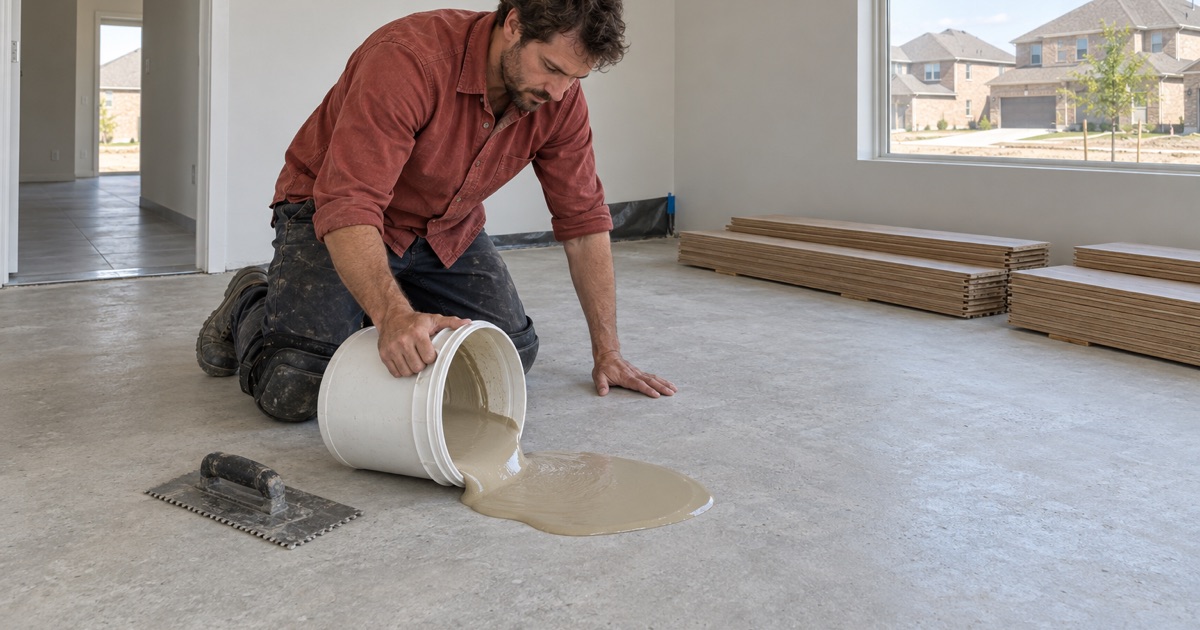
Concrete keeps releasing moisture long after a house is finished and occupied, and a floor glued or floated over a slab that is still wet fails in ways that get blamed on the installer. In the newest houses in town this is the largest single risk in the job.
Testing before a date is set
We run an ASTM F2170 in-situ relative humidity test in the slab itself, plus a calcium chloride test or pinless moisture meter readings on the wood, before an installation date goes on the calendar. Testing after the material is on site turns a measurement into an argument.
If the numbers come back high, the answer is a vapor retarder, a different installation method, or a delay — and we would rather move a date than warranty a floor we expect to cup. It is the same reasoning behind acclimating boards inside the house instead of in a garage.
Flatness, grinding and underlayment
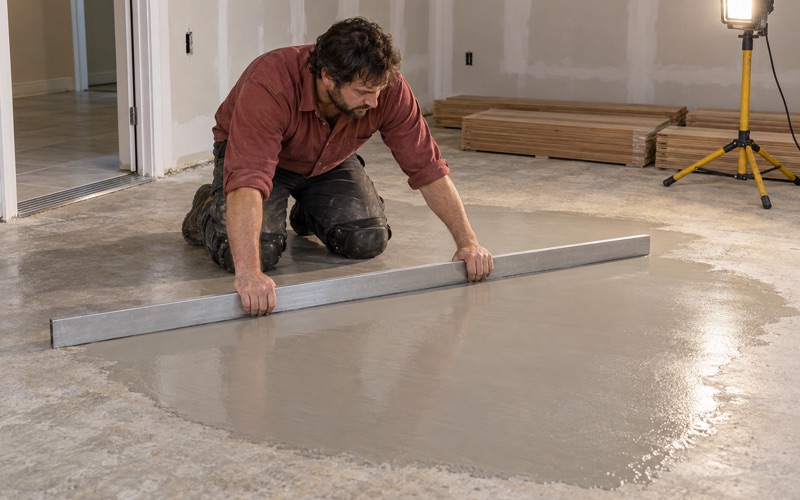
A new slab is not automatically a flat one. Where subfloor flatness tolerance is out, we correct it with concrete grinding on the high spots and self-leveling underlayment in the low ones before any adhesive goes down.
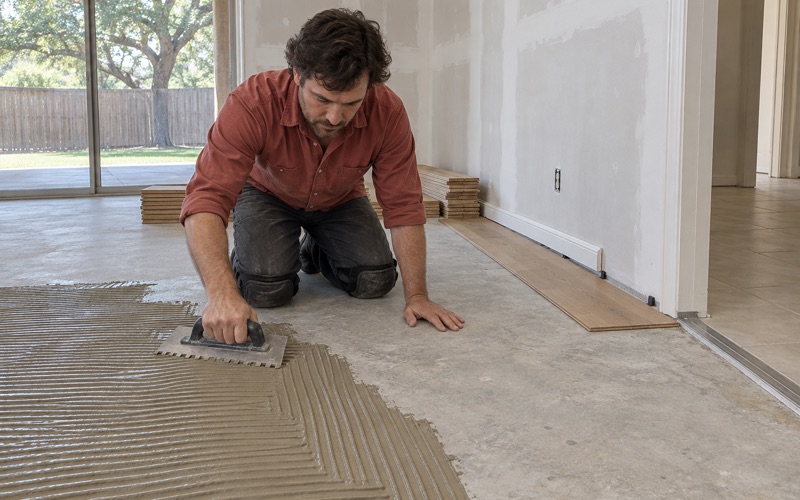
Fastening choices follow from that same survey. Glue-down installation direct to concrete, floating installation and nail-down installation over a sleeper system each behave differently, and on a post-tension slab nothing is fastened into the concrete at all.
The code edition the city has actually adopted
Oak Point has adopted the 2021 editions of the International codes — IBC, IRC, IECC, IFC, IFGC, IMC, IPC, IEBC and the Pool and Spa Code — along with the 2020 National Electrical Code, all with local amendments. We work to the edition your town has adopted rather than a generic national one.
It shows up in the paperwork as well. Single-family residential permit submissions to the City of Oak Point Building Inspections Division require an engineered foundation letter identifying the applicable building code, so foundation design documentation is a submission requirement here rather than an optional attachment. We sequence a floor after foundation and plumbing work for the same reason.
Large lakeside lots, wells and what the city registers
Oak Point covers 6.10 square miles, 5.79 of them land, on a peninsula in Lewisville Lake. Having that much ground with water on three sides of it changes site access far more than it changes the floor.
What the city registers, and what it does not
Electrical contractors, plumbing contractors, septic installers and water well drillers all have to register with the city annually before any permit is issued, filing an application, a fee, a driver’s license copy, a state registration copy and proof of insurance. Flooring and general remodeling contractors are not named in that registration list.
We raise it because it changes who you are waiting on. When a floor follows a leak repair, the plumber’s registration is the gate on the permit, and knowing that in advance keeps a week from vanishing between two trades.
Septic systems, private wells and long driveways
That the city registers septic installers and water well drillers at all tells you parts of Oak Point run on on-site sewage facilities and private wells rather than municipal utilities. It is a rural service pattern, and it arrives with large lots and long driveways.
For us that means settling the delivery and staging plan before a truck turns in. Boards still have to come inside to acclimate, containment still has to run from the work area to a door, and a long driveway is a question worth answering the week before rather than the morning of.
The rest of the site routine does not change on a large lot. We move furniture out and put it back, and the rooms we are working in are cleaned at the end of each day rather than at the end of the job. On a house set well back from the road, that daily reset is what keeps the place livable while the work runs.
Sandy loam, seasonal movement and the gaps it opens
Denton County soils mapping shows fine sandy loam and loamy fine sand through the Oak Point area, inside the Eastern Cross Timbers band. Sandy loam drains and moves differently from heavy clay, but no slab in this county sits perfectly still through a wet spring and a dry August.
So we build for the movement instead of pretending it away. An expansion gap at every wall and vertical, the right transitions — T-molding, a reducer, quarter round scribed down to the boards — and a straight conversation about seasonal gapping are what keep an ordinary winter from looking like a defect.
- 20+ Years on Wood Floors
- Dustless Sanding and Containment
- Written Scope Before Work Starts