
Flower Mound Wood Flooring installs solid hardwood flooring in Flower Mound, TX, with more than 20 years of wood floor experience behind the work. Solid hardwood is the traditional floor: one piece of wood through its full thickness, fastened down into a wood subfloor, and sandable as many times as its thickness allows.
That last quality is the whole argument for it. A solid floor is not a surface you eventually replace, it is a surface you maintain, and a well-installed one can outlive several rounds of everything else in the room. Where there is a sound wood subfloor to fasten into, it remains the floor with the longest useful life you can buy.
The honest constraint is the subfloor itself. Most housing in this area sits on a concrete slab, and a solid floor cannot simply be nailed to concrete. Where we have a wood deck, solid hardwood is an excellent choice and we will say so. Where we have a slab, we will explain what building a fastening substrate over it actually costs in money and in finished floor height, and usually recommend engineered instead.
What Solid Hardwood Is
One Piece of Wood, Full Thickness
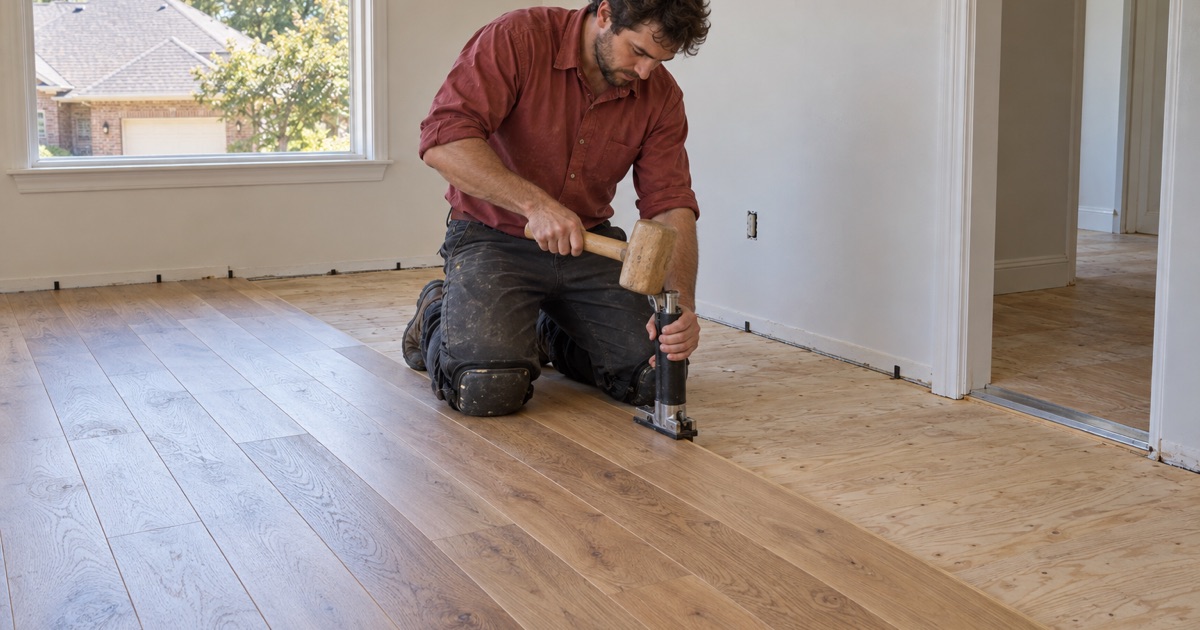
A solid board is milled from a single piece of lumber with a tongue on one edge and a groove on the other, and the wood you see on the surface continues all the way down to the bottom of the board. There is no core, no veneer and no bonded layer to fail. That construction is why the floor can be sanded repeatedly and why it moves the way it does with humidity.
How Many Refinishes You Actually Get
The usable thickness is the wood above the top of the tongue, since sanding into the tongue destroys the joint. That gives a solid floor several sandings across its life, which in practical terms is decades of maintenance rather than replacement. We measure the remaining thickness on an existing floor at a vent or threshold, and we tell you the honest figure rather than a marketing one.
Seasonal Movement and Why It Is Normal
Solid wood takes on and gives up moisture with the air around it, expanding across its width in humid months and shrinking in a dry heated winter. Hairline gaps that open and close with the seasons are the floor behaving correctly. Managing that is a matter of correct acclimation, correct expansion gaps and reasonably stable indoor humidity, not of finding a product that does not move.
Installing Over a Wood Subfloor
Nail-Down Fastening
Solid flooring is fastened with flooring cleats or flooring staples driven at an angle through the tongue, so no fastener shows on the finished surface. Fastener type, spacing and crown width all come from the manufacturer’s instructions and from the subfloor material. A nailer set too aggressively crushes the tongue and creates the squeak the homeowner hears two years later.
Subfloor Flatness and Preparation
Before any board goes down, the subfloor is checked against the flatness tolerance the flooring product specifies, and any panel that is loose, water-damaged or delaminated is re-fastened or replaced. Old fasteners and adhesive come off, and the deck is swept clean. Almost every complaint about a finished nail-down floor traces back to something skipped at this stage.
Moisture Readings on Both Sides
We take pinless moisture meter readings on the subfloor and on the delivered flooring and compare them, because it is the difference between the two that predicts trouble rather than either number alone. Flooring installed dry into a damp subfloor will cup as it equalizes, and flooring installed wet will gap. Installation waits until the readings are inside the range the product calls for.
Species, Grade and Format
Red Oak, White Oak and Hickory
Red oak is the most widely installed domestic species and the one already down in most older houses here, with warm undertones and a strong open grain that hides wear. White oak is a little harder, reads cool and neutral, and is what current light and gray-toned finishes are built around. Hickory is harder again and swings dramatically in color between boards.
Grade, Width and Length
Grade describes appearance rather than strength: a select grade gives a clean, uniform floor while a character or rustic grade brings knots, streaks and color variation. Narrower boards read traditional and move less; wider boards read contemporary and move more. Longer bundles mean fewer end joints. All three decisions affect the layout plan and the material order.
Prefinished Versus Site-Finished
Prefinished boards arrive coated from the factory with micro-beveled edges and go into service quickly. Site-finished floors are installed raw, sanded flat as one continuous plane and coated in place, which gives a seamless surface with no bevel lines and lets you pick the exact stain and sheen level. Site-finished is also the far easier route when you are matching into an existing floor.
Acclimation, Layout and Finishing Details
Acclimating Inside the House
Material is delivered into the rooms it will live in and left at the conditions the house actually runs, not in a garage, a truck or an unconditioned space. We measure rather than count days, taking readings on the stacked material until it settles into equilibrium with the subfloor. This step costs patience and prevents the two most common complaints about a new solid floor.
Expansion Gaps and Perimeter Detail
A solid floor needs somewhere to expand, so a gap is held at every wall, cabinet toe kick, column, hearth and door jamb, sized to the width of the field and the product. Baseboard and quarter round hide it. A floor laid tight to the walls has nowhere to go in a humid month, which is how buckling and tenting begin.
Transitions, Thresholds and Board Direction
Direction is usually set by the longest sightline, constrained by the joist run, since boards should cross the joists rather than run parallel with them. Where the floor meets tile, carpet or a different height, T-molding, a reducer or a threshold carries the change. We set the layout, the starting line and every transition before installation, because none of it can be revised once the field is fastened down.
- 20+ Years on Wood Floors
- Dustless Sanding and Containment
- Written Scope Before Work Starts