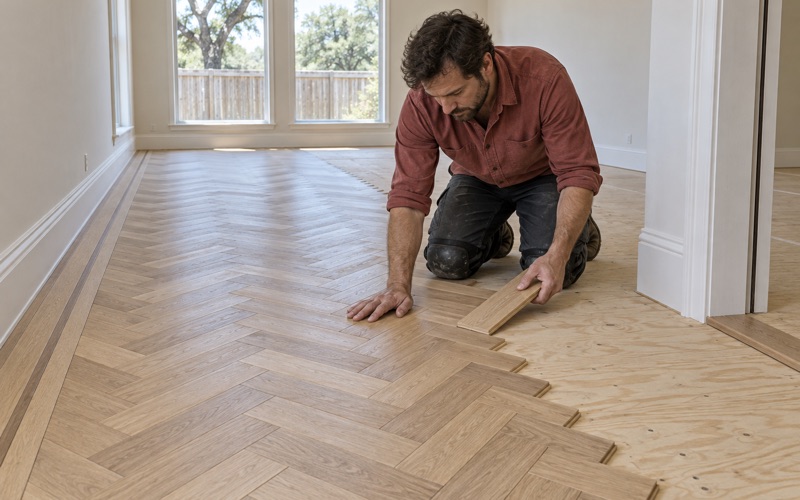
Flower Mound Wood Flooring sands, refinishes and installs wood flooring in Southlake, and we have been doing it for more than twenty years, with the last two decades of that spent on North Texas slabs rather than on plywood subfloors somewhere else. Concrete changes how a floor is fastened, what has to be tested before anyone commits to an install date, and what goes wrong with the floor later.
Most of the calls that reach us from this city concern floors somewhere between twenty-five and thirty-five years old. The finish has gone flat in the traffic lanes, the boards in front of the sink have darkened, and the gaps that open every January are wider than they were a few winters ago. Some of those floors need a screen and recoat. Some are well past it.
Which one you have is a question we answer on your floor rather than over the phone, and the answer goes into a written scope before work starts, so the price is not discovered halfway through. What follows is how that decision gets made on the housing this city actually has.
Why so many Southlake floors need the same work at the same time

One decade built most of the city
Of Southlake’s 9,612 housing units, 4,327 — 45.0 percent — were built between 1990 and 1999, according to the 2024 five-year American Community Survey. Another way to read the same table: 94.75 percent of the city’s units date from 1980 or later, and only 326 of them, about 3.4 percent, go back to the 1970s.
The population behind that decade climbed just as steeply. Southlake counted 7,158 residents in 1990, roughly 20,000 by 1998 and 21,519 in 2000. The tract that became the 130-acre Southlake Town Square was bought in March 1996 and its first phase opened in 1999 — the same window in which most of the floors we are asked to look at today were being nailed and glued down.
The same floors, wearing out on the same schedule
A single-decade cohort means a single generation of flooring. 94.31 percent of the city’s units are single-family detached, and 8,421 of them are owner-occupied single-family detached houses, so the stock is unusually uniform: site-finished red oak and white oak, some early engineered hardwood, some prefinished plank, installed by the handful of methods that were standard at the time.
That uniformity is useful to a homeowner. Wear patterns, finish chemistry and installation details repeat from house to house and often across a whole subdivision, so an estimate here starts from better information than it would in a neighborhood assembled over sixty years. It also means the work arrives in clusters, with one street’s floors reaching the end of their finish life within a season or two of each other.
Homes that stay occupied while we work
94.56 percent of occupied units in the city are owner-occupied, and only 502 of 9,229 are rented. Practically, that means we are almost never refinishing an empty house between tenancies. There is a family living around the work, which makes dust containment, phasing and off-gassing schedules part of the job rather than an afterthought.
So we sand with containment and seal the rest of the house off from the work area, move the furniture out and put it back, and leave each room clean at the end of the day. One crew runs the job from the first day to the last, and the sanding is never handed to a subcontractor.
Looking for wood-flooring closer to Roanoke? See Wood-Flooring Services in Roanoke.
Recoat or full sand: how we decide on a 1990s floor
Bond testing before a finish goes down
Site-finished oak from this era was commonly sealed with oil-modified polyurethane. Whether a fresh coat will bond to what is already down is not something anyone can read off the age of the house. It has to be tested on the actual floor, in an out-of-the-way spot, before we will quote a recoat.
When the bond holds, the answer is a screen and recoat: abrade the existing finish with a buffer and screen, then lay one new coat over it. That is the cheapest honest answer available, and we give it when it is the true one. We price the repair-depth ladder straight, so if a recoat will do the job, we say so instead of selling a full sand.
When the floor has to come back to bare wood
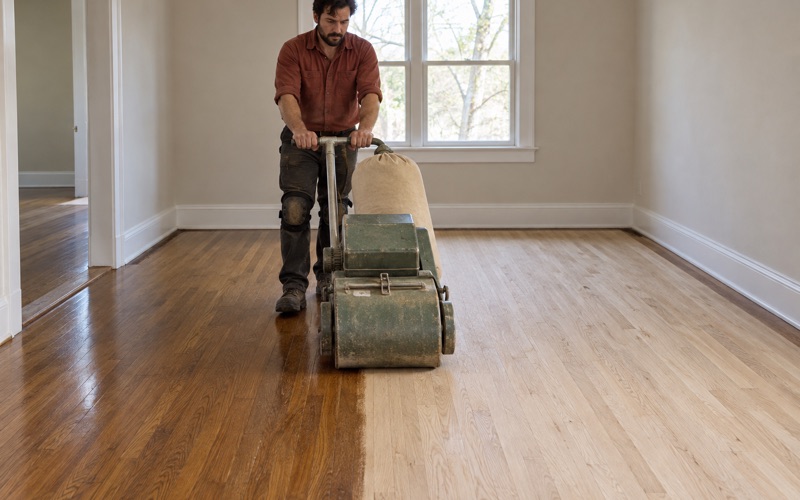
A failed bond test settles the question, and so do scratches that have gone through the finish into the wood, gray water staining, pet damage, or edges that have built up under too many coats. From there it is a full sand: a proper grit sequence with the drum sander through the field, an edger at the perimeter, and a buffer to blend the two before any finish goes on.
Engineered floors need one measurement first. Wear layer thickness decides whether a full sand is possible at all, since a thin veneer will take a screen and recoat but not a drum, so we check it at a vent cut or a transition rather than guessing from what the box said.
Finish and sheen in a house nobody is moving out of
Waterborne polyurethane cures quickly and stays clear, oil-modified polyurethane ambers over time and takes longer to walk on, and hardwax oil is repairable in place but asks for a maintenance habit. When the family is staying put, cure time and odor weigh as heavily as durability, and we schedule the coats around that.
Sheen level deserves more thought than it usually gets. A lower sheen forgives the surface texture of a thirty-year-old floor and hides the next round of dog scratches, and it is far easier to match against an adjacent room that is not being refinished.
Working over a post-tensioned slab
Locating the tendons before a fastener goes in
The dominant construction here is slab-on-grade with a post-tensioned tendon layout. Those tendons are under load, they are not where anyone assumes they are, and cutting one is not a repair that belongs in a flooring budget. Any fastened system over one of these slabs begins with the tendon plan or a scan, and with marks on the concrete before a fastener goes in.
That is a real constraint on nail-down installation, which needs a sleeper system or a plywood subfloor anchored down first. Flooring cleats, flooring staples and the right fastener crown width matter for how the boards hold; the anchors into the slab are the part that has to be located.
Glue-down and floating, and what the slab has to be
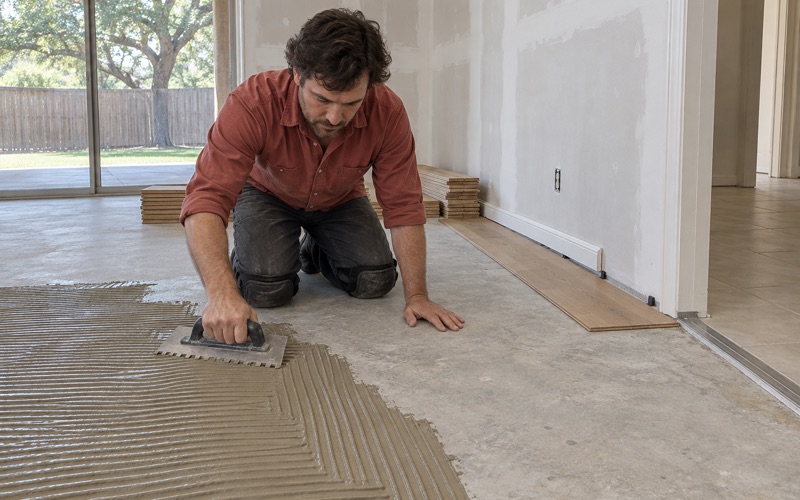
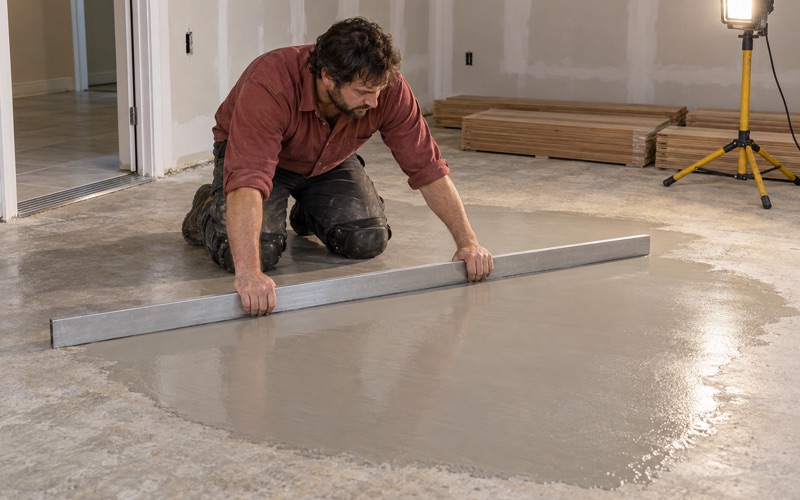
Glue-down installation and floating installation sidestep the tendon question entirely, because nothing penetrates the slab. What they ask for instead is flatness. Glue-down has a subfloor flatness tolerance to meet, which usually means concrete grinding on the high spots and self-leveling underlayment in the low ones before an adhesive trowel comes out.
A floating floor needs an expansion gap at every wall and vertical, hidden afterward by base and quarter round, plus T-molding and a reducer where it meets tile or carpet. On these slabs the installation method is chosen by what the concrete allows, not by preference.
Moisture, and a slab that is still moving
We test the slab for moisture before an installation date is set, not after the boards are on site. That means ASTM F2170 in-situ relative humidity probes in the concrete, a calcium chloride test where it is the right tool, and a pinless moisture meter on the wood itself. The vapor retarder and the adhesive are specified from those readings.
The ground underneath complicates it. Eastern Tarrant County sits in the Eastern Cross Timbers, a band averaging no more than fifteen miles wide of sandy to loamy, acidic-to-neutral soils weathered from the Woodbine sand formation, which separates the Blackland Prairie on the east from the Grand Prairie on the west. Blackland-adjacent expansive soil still drives seasonal shrink-swell under these slabs.
A post-tensioned slab is stiffer than a conventional one, but stiffness does not stop soil from moving. Doming and dishing reach the finish floor as cupping, seasonal gapping and squeak in the same places year after year. Where a house has foundation work or a plumbing repair ahead of it, we sequence around that instead of laying a new floor over a slab that is still on the move.
Installation, repair and stairs in Southlake homes
Repairs that stop short of a new floor
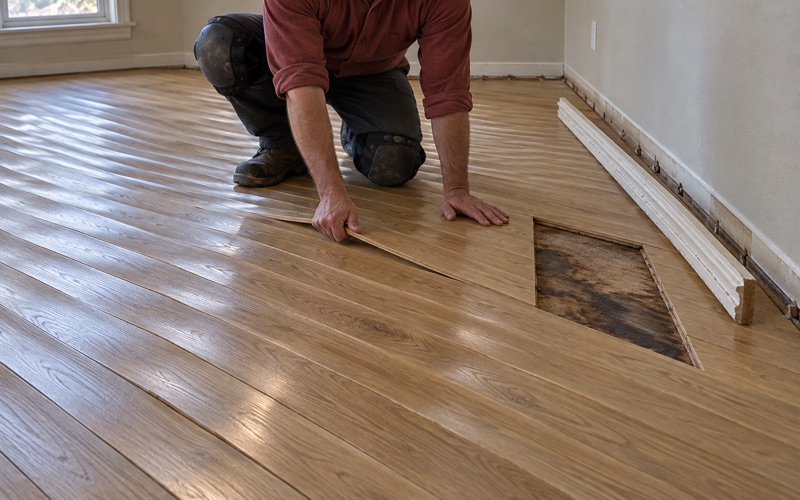
A damaged run does not always mean a new floor. Board replacement laced into the surrounding field, a weave-in repair rather than a square patch, reads as part of the floor once it has been sanded and finished, and a dutchman patch handles a localized defect without disturbing much around it. Matching species and plank width is most of that work, since red oak, white oak and hickory take stain differently and their Janka hardness rating shows up in how they wear.
Water damage jobs come with the paperwork a claim needs: dated photographs, moisture readings taken as the floor dries, and an itemized scope. When an insurer is involved, that record is worth as much as the repair.
Stairs, transitions and trim
Stairs are their own job. Treads and risers in a house of this vintage are often still carpeted over builder-grade stringers, and taking them to hardwood means a stair nosing profile that matches the floor it meets and a tread thickness the existing rise can absorb.
The flat work gets the same attention. T-molding and reducers land at doorways, quarter round covers the expansion gap where it needs covering, and shoe molding follows the floor rather than fighting it.
Acclimation, code and scheduling a whole house
Boards acclimate inside your house, not in the garage and not on the truck, before a single one is fastened down. We also work to the code edition your town has actually adopted rather than a generic national one: Southlake adopted the 2021 International Residential Code by Ordinance No. 1252, effective May 1, 2022, and permits and inspections here run through City of Southlake Building Inspections, in Tarrant County.
Whole-house refinishing is the other thing this housing stock keeps asking for, and it is a scheduling problem as much as a sanding one. We either phase it so there is a path through the house and somewhere to sleep, or compress it into one stretch while the family is away, and we settle which of those it is in the written scope before the first machine comes off the truck.
- 20+ Years on Wood Floors
- Dustless Sanding and Containment
- Written Scope Before Work Starts